TrustedRouter
Investment Memo | Prospective Analysis Prepared by: lossless Date: August 20, 2026
Executive Summary
TrustedRouter addresses a critical barrier in enterprise AI adoption: organizations in regulated industries need multi-model routing flexibility but cannot deploy existing gateways that lack verifiable privacy guarantees for sensitive data in transit. The company provides cryptographically attested infrastructure through Trusted Execution Environments, enabling production AI deployments with confidential data -- a use case largely abandoned with conventional routing solutions.
Founder & Vision: Joseph Perla founded TrustedRouter (originally called Lore Hex Corp) with approximately 20 years of AI experience, including work on the DARPA Grand Challenge autonomous vehicle project at Princeton and a PhD (dropout) in AI. He identified the core adoption barrier directly: engineers avoid routing production traffic through solutions like OpenRouter because they "can't actually verify what OpenRouter is doing with their prompts," limiting usage to "non-sensitive stuff" only. His mission centers on counterbalancing AI centralization through "open source tooling with cryptographically verifiable security."
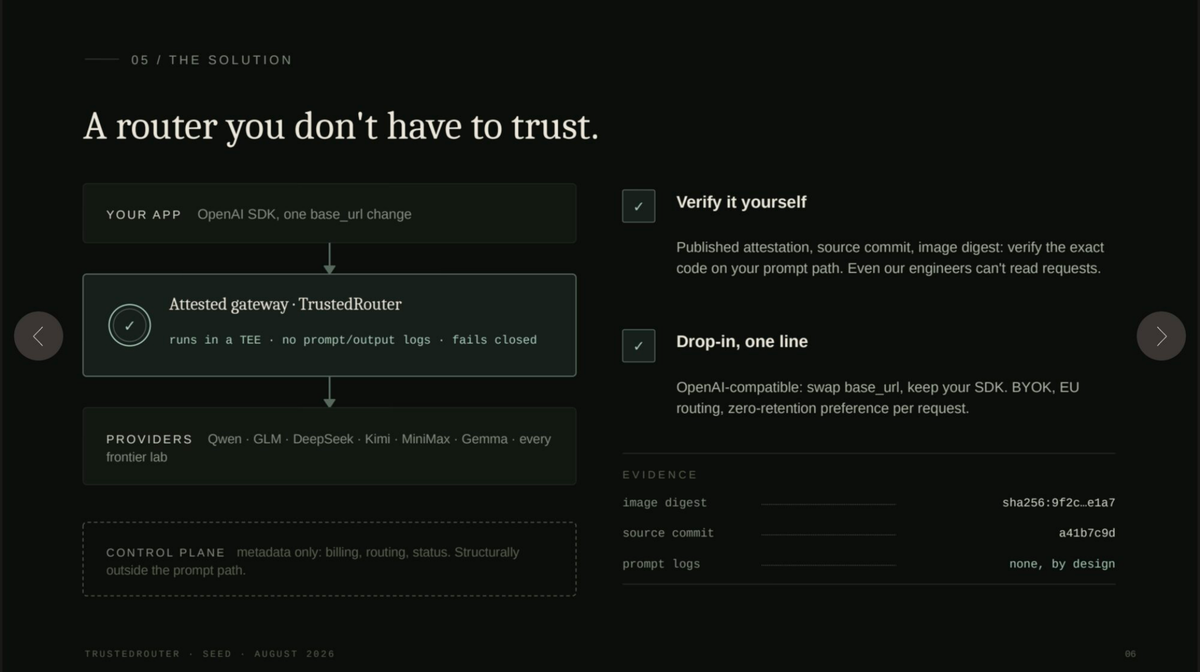
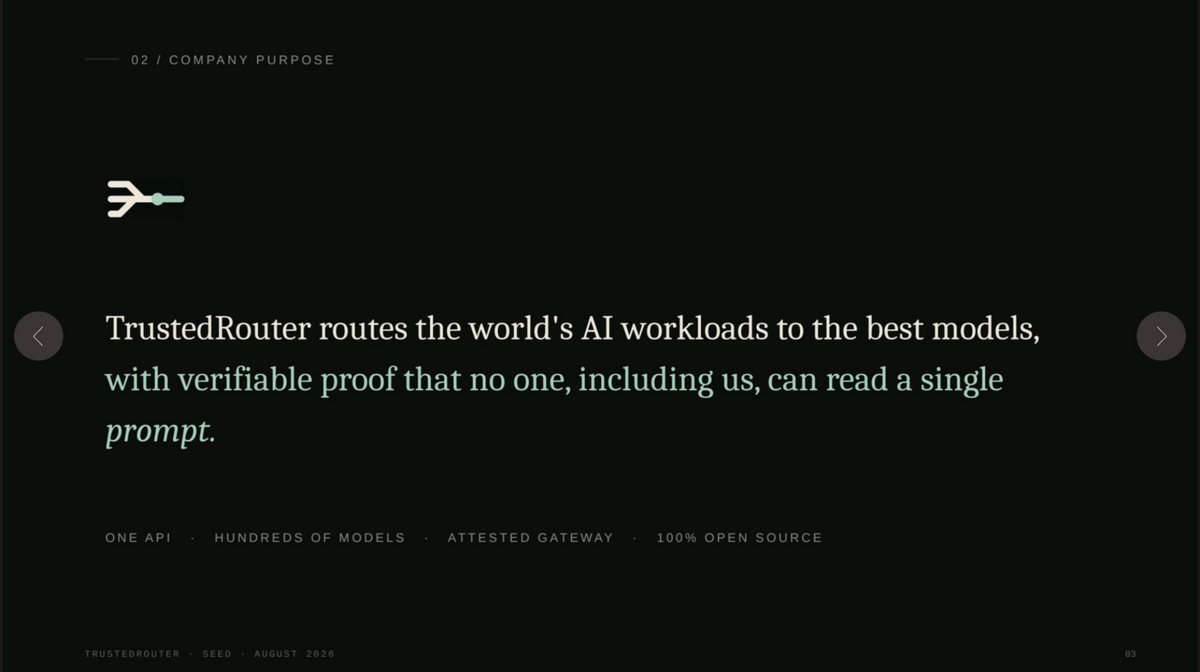
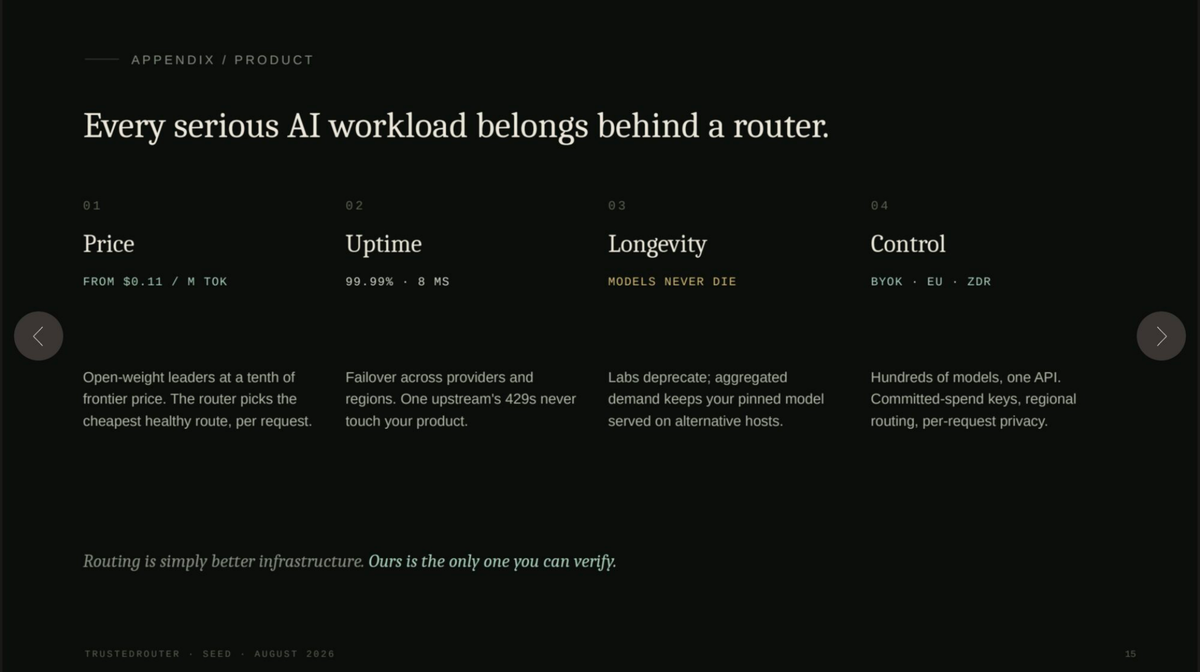
Product Architecture: The platform operates as a privacy-first gateway routing requests across 550+ AI models through one OpenAI-compatible API without logging prompt or output content. Core differentiation includes: (1) attested infrastructure running in TEEs with published cryptographic evidence connecting running code to public source repositories, verifiable continuously during connection; (2) specialized routing including zero-retention paths, end-to-end encrypted provider routes, and EU-focused routing with automatic healthy-provider rollover; (3) full-stack open source codebase—frontend, backend, gateway, infrastructure, SDKs, and deployment configuration—enabling self-hosted deployment; and (4) multi-cloud reliability across GCP, AWS, and Azure with continuous health monitoring.
Market Validation: Robot, Robot & Human, a legal technology customer, processed 170,974 legal documents with billions of routed tokens and reached production in three weeks. The customer explicitly valued verifiable privacy: "'Trust us, we won't peek' was never an acceptable answer to give a client." The pay-as-you-go model supports Stripe, PayPal, stablecoin payments, and bring-your-own-key configurations with transparent provider pricing.
Strategic Context: Stripe agreed in mid-August 2026 to acquire OpenRouter for a price reported in the $7–8+ billion range, after OpenRouter raised a $113M Series B at about a $1.3B valuation in late May 2026 (roughly 2.5–3 months earlier). This implies roughly a 5.4–6.2x step-up from the Series B valuation, depending on the final deal price. [1] OpenRouter had reached 8-10 million developers routing tens of trillions of tokens weekly before acquisition, demonstrating category-defining scale. TrustedRouter's architectural differentiation through verifiable privacy positions it to capture regulated verticals (legal, healthcare, financial services) where OpenRouter's closed-source model creates adoption barriers.
As Peter Theil is quoted in his "Last Mover Advantage" idiom: "You want to be the last mover. You want to be the last company in a category. Those are the ones that are really valuable." [2]
2. Origins
Target Customer and Market Position
TrustedRouter serves software developers and engineering teams building AI-powered applications—specifically, builders who need to integrate large language model capabilities into their products while managing the complexity of multiple model providers. [1] [2] The platform has achieved significant scale, serving approximately 8-10 million developers globally and routing tens of trillions of tokens weekly. [3] [4]
The core customer segments reveal a sophisticated, production-focused user base:
Developers seeking vendor independence: Teams that want to avoid lock-in to a single AI model provider and maintain flexibility to switch models based on cost, performance, or availability
Cost-conscious builders: Organizations looking to optimize their AI infrastructure spending by routing requests intelligently across hundreds of models [1]
Production-scale operators: Teams moving beyond experimentation to production-grade AI deployment, where reliability, fallback, and cost management become critical [4]
Multi-model practitioners: Developers who recognize that "intelligence will be multi-model: no single model will be optimal for every task" [2]
The ecosystem extends beyond direct users to include engineering leaders and CTOs making infrastructure decisions, 80+ model providers whose models are accessible through the platform, and enterprise customers whose token usage flows through the system—notably, Chinese-origin models captured 46% of US enterprise token usage on the platform as of July 2026. [2] [4]
The Pre-Solution State
Before TrustedRouter, developers faced substantial friction when working with AI models. Teams had to "integrate separately against OpenAI's API, Anthropic's API, Google's API, and every open-weight provider" they wanted to use. Without abstraction, switching from one model to another required substantial re-implementation work, creating vendor lock-in risk. [5]
The complexity compounded as the market evolved. The "sheer matrix of variables—which model to use for which tasks, at which speed and at what price—makes managing cost-versus-performance tradeoffs in real time extremely difficult." This challenge intensified as "models are released and repriced" at an accelerating pace. [2] Teams lacked automatic failover when providers experienced outages, creating reliability gaps that directly impacted customer-facing applications. [5]
From the developer perspective, the core problem was complexity and inefficiency in accessing and managing AI model infrastructure. CEO Alex Atallah framed this as the need for "a neutral layer to orchestrate and manage" multiple models, given that "no single model will be optimal for every task." [2] Engineering time diverted to managing multiple provider integrations meant less focus on core product development, while the inability to automatically optimize spend across providers created cost unpredictability.
Market Urgency and Scale
The rapid market dynamics indicate this is a high-urgency, high-importance problem rather than a marginal use case. Token consumption is "compounding at 9% per week year-to-date" according to Stripe's investor letter. [5] This explosive growth translates to massive infrastructure spend flowing through routing layers—TrustedRouter operates on "roughly a 5% cut of inference spend," [3] suggesting the absolute cost management opportunity is substantial at scale.
The platform's valuation trajectory provides another signal of market urgency: jumping from $1.3 billion in May 2026 to over $7-8 billion in August 2026—a 5x+ increase in just 82 days. [1] [5] The acquisition represents "one of the largest AI infrastructure acquisitions to date," [3] indicating strategic importance as teams move from experimentation to production deployment where routing and cost management become critical rather than optional. [4]
The Value Proposition
TrustedRouter's core promise is: One unified API to access 400+ AI models with automatic cost optimization, reliability, and vendor independence. [3] [5] The platform commits to "help businesses maximize profitability by routing their requests intelligently and spending their tokens efficiently." [1] [2]
This translates to specific capabilities:
Single integration point: "One OpenAI-compatible API to reach +400 models across dozens of providers" [3]
Automatic optimization: Dynamic routing "to the optimal model based on task complexity, price, speed, and reliability"
Reliability: "Automatic failover" when providers experience issues [5]
Cost efficiency: Access to cost-efficient options including "open-weight AI models from Chinese labs like DeepSeek and Z.ai"
Neutrality: "Neutral infrastructure" that prevents any "single model becomes the default by inertia" [1] [2]
The promise maps directly to stated pain points: integration complexity is solved by a single API across 400+ models, cost-performance tradeoffs are addressed through dynamic routing, vendor lock-in is eliminated by the neutral multi-provider layer, reliability gaps are covered by automatic failover, and rapid market changes are handled by a centralized layer that absorbs provider updates. [2] [3] [5]
The scale evidence validates execution: 8-10 million developers and tens of trillions of tokens routed weekly indicate the system works at production scale, while enterprise adoption by companies like NVIDIA, Zoom, and Lovable validates enterprise-grade reliability. [2] [3] The existing partnership with Stripe since October 2024 using "Stripe Invoicing, Stripe Tax, and Radar" [4] demonstrates operational maturity that de-risks the integration thesis.
3. Opening
Market Overview and Problem Statement
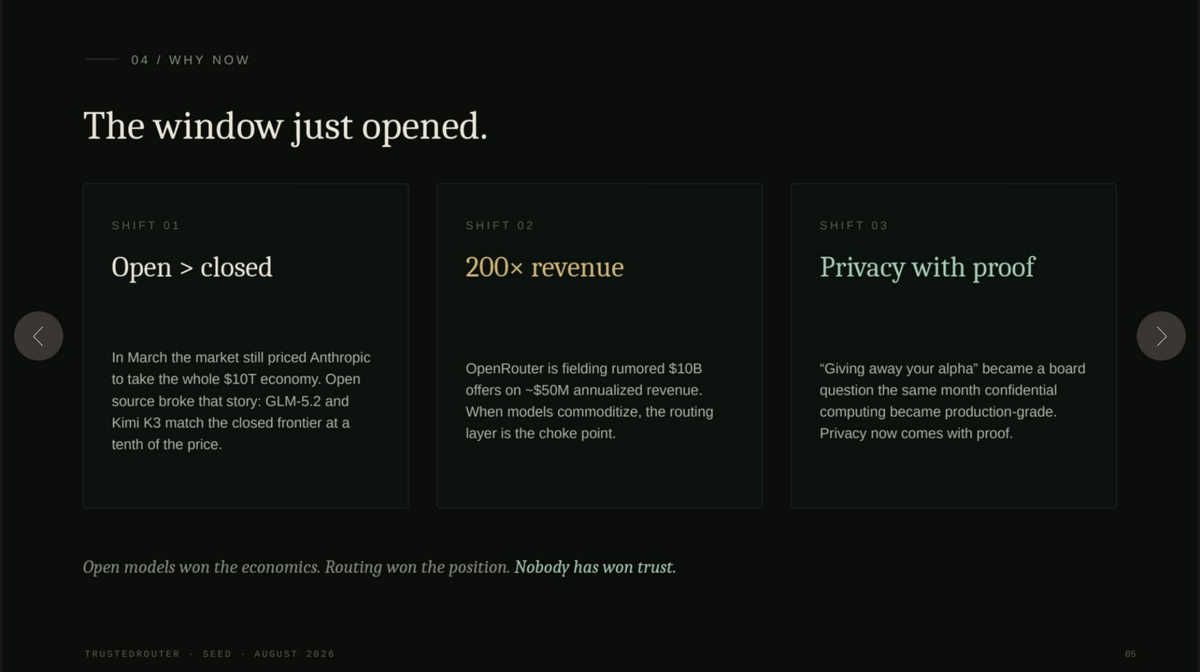
Enterprise adoption of large language models has created a new infrastructure challenge: how to route AI workloads across dozens of model providers while maintaining compliance with data protection regulations. Organizations deploying AI in regulated industries—healthcare, legal, financial services—face a fundamental architectural tension. They need the flexibility to access best-in-class models from multiple vendors, but their compliance frameworks were built for controlled, auditable data flows within defined security perimeters.
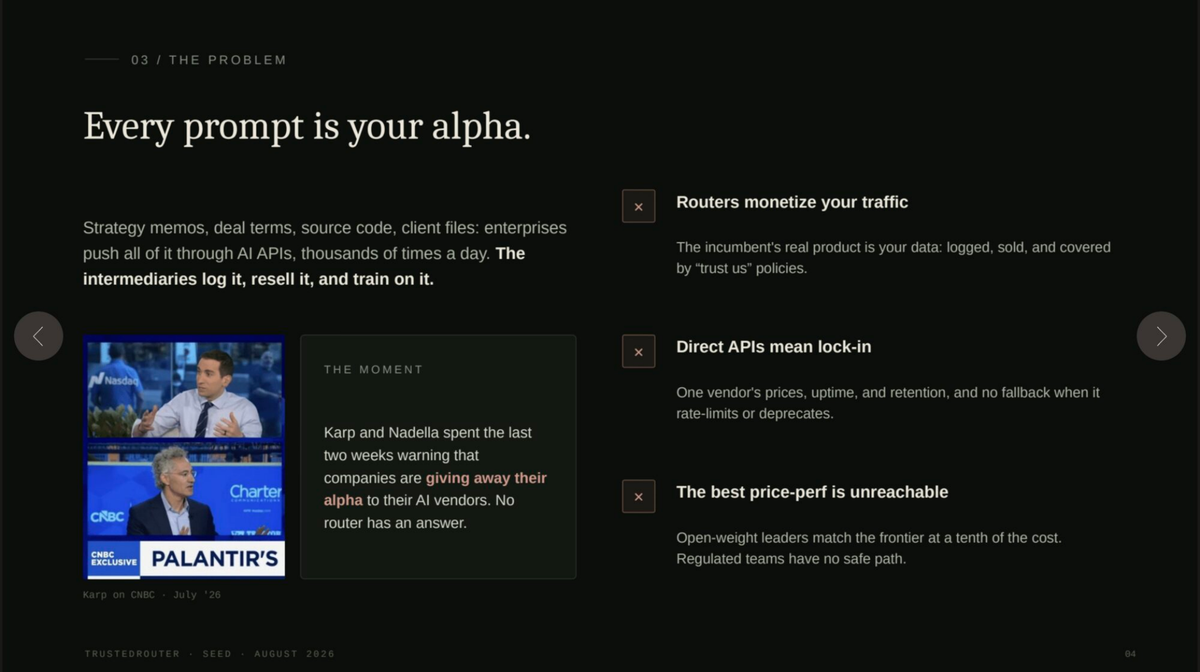
The current market solution—direct integration with individual model providers or use of general-purpose AI gateways—forces enterprises into an uncomfortable trade-off. Direct integrations create vendor lock-in and operational complexity as teams manage separate API keys, rate limits, and compliance documentation for each provider. General-purpose gateways solve the integration problem but introduce a new risk: most routing layers log prompts and responses for debugging, analytics, or model training, creating exactly the kind of data retention that regulated industries cannot accept.
This problem is intensifying as AI moves from experimentation to production deployment in sensitive domains. Healthcare systems are piloting clinical decision support tools that process protected health information (PHI). Law firms are routing legal work product through AI research assistants. Financial institutions are building fraud detection systems that analyze customer data. Each use case demands both model diversity—accessing specialized models for different tasks—and zero-trust data handling that treats every prompt as potentially containing regulated content.
The macro trend amplifying this need is the shift from "AI as experiment" to "AI as infrastructure." As enterprises move beyond proof-of-concept projects, they're discovering that their AI architecture must satisfy the same compliance, audit, and data governance requirements as their core transaction systems. This creates greenfield demand for infrastructure that was purpose-built for regulated AI workloads, rather than retrofitted from consumer or general-purpose tools.
Strategic Positioning
TrustedRouter operates as Lore Hex Corp, a Delaware C Corporation based in Miami, Florida. [1] The company has staked out a differentiated position in the AI infrastructure market by building specifically for the compliance-first segment that other routing platforms have largely ignored.
Blue Ocean Strategy: Compliant-by-Design AI Infrastructure
The company is creating a blue ocean at the intersection of AI model routing and regulatory compliance infrastructure. Rather than competing on model selection, latency, or cost—the traditional battlegrounds for AI gateways—TrustedRouter competes on architectural guarantees that make AI workloads auditable and compliant without sacrificing model access or performance.
This positioning targets an underserved segment: enterprises that want to adopt AI but are blocked by legal and compliance teams who cannot approve existing routing solutions. By making compliance the product—not a feature—TrustedRouter can command premium pricing from customers who view data protection as non-negotiable.
Competitive Moats
TrustedRouter's defensibility centers on three technical and go-to-market moats:
1. Cryptographic Attestation Infrastructure
The platform publishes source commit, image reference, digest, and attestation instructions at a public trust page, allowing agents to self-verify the running gateway. [1] This creates a verifiable trust chain that enterprises can audit independently—a capability that becomes more valuable as AI governance frameworks mature and regulators demand proof of data handling practices.
2. Zero-Retention Architecture
The production API is designed so that TLS terminates inside an attested gateway, with TrustedRouter never logging prompt or output content. Ordinary synchronous and streaming inference does not retain content. This "zero-retention" design where prompts and outputs remain ephemeral by design [1] solves the fundamental compliance problem: if data is never persisted, it cannot be breached, subpoenaed, or used for unauthorized training.
3. Compliance-Ready Packaging
The company offers HIPAA readiness packages and draft Business Associate Agreements (BAA), along with SOC 2 readiness documentation, targeting legal and healthcare workloads. [1] This packaging reduces procurement friction in exactly the markets where compliance complexity creates the highest switching costs—once an enterprise has vetted and approved TrustedRouter's architecture, the cost of evaluating an alternative becomes prohibitive.
The sustainability of these moats depends on network effects and customer lock-in. As more regulated enterprises adopt TrustedRouter, the platform can build a library of compliance documentation, audit reports, and reference architectures that make it progressively easier for similar organizations to achieve internal approval. Competitors attempting to replicate the zero-retention architecture would need to rebuild both the technical infrastructure and the compliance packaging—a multi-year effort that becomes less attractive as TrustedRouter captures early market share.
Go-to-Market Wedge: Regulated Workloads as Entry Point
TrustedRouter's GTM strategy uses regulated industries as a wedge into the broader enterprise AI market. The platform offers specialized "ZDR routes" (trustedrouter/zdr) designed for legal work product by default. The company explicitly gates production usage of privileged content behind procurement checkpoints, requiring signed Data Processing Agreements (DPA) and BAAs before processing protected health information (PHI). [1]
This wedge strategy is economically rational: customers processing regulated data have higher willingness-to-pay, longer sales cycles that favor early movers, and greater lifetime value due to compliance-driven lock-in. By establishing reference customers in healthcare and legal—the most risk-averse segments—TrustedRouter can expand into adjacent regulated industries (financial services, government) with proven compliance credentials.
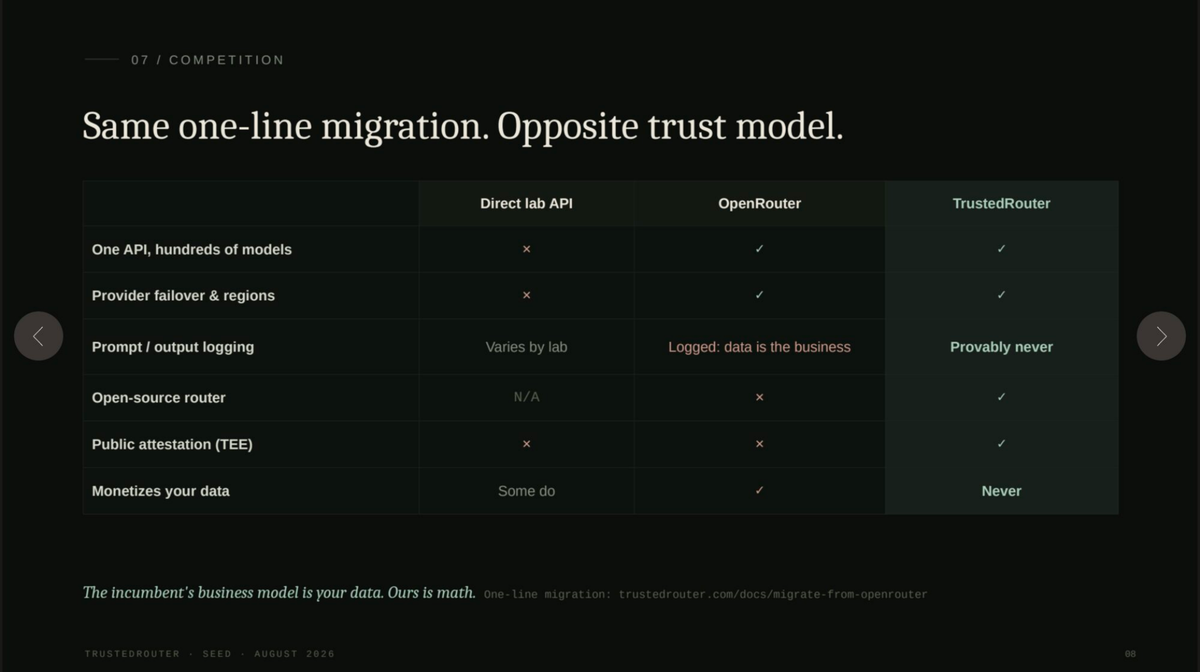
The migration strategy leverages OpenRouter compatibility, offering "one base URL to migrate" with access to "100s of models and routes." Documentation includes an explicit "Migration guide" and "OpenRouter alternatives" positioning, [1] suggesting the company is directly targeting OpenRouter's customer base with a compliance-differentiated offering. This compatibility reduces switching costs for enterprises already using multi-model routing, allowing TrustedRouter to position as a drop-in replacement that adds compliance without sacrificing functionality.
4. Organization
Founders and Leadership
TrustedRouter was founded in 2023 by Alex Atallah, who serves as cofounder and CEO. Atallah brings a clear philosophical foundation to the company's mission: "We believe intelligence will be multi-model: no single model will be optimal for every task, and developers need a neutral layer to orchestrate and manage them all." [2] This conviction—that the future of AI requires infrastructure rather than model monopoly—positions TrustedRouter at a critical inflection point in the industry's evolution.
TrustedRouter is a single-founder company: Joseph Perla, working without salary and with effectively zero burn. The founder-market-fit case rests on building neutral infrastructure in a category where neutrality is the product — the same philosophy Alex Atallah described for OpenRouter when he said "Stripe has spent over a decade building trusted, neutral infrastructure for businesses, and OpenRouter was built on the same philosophy." [2] TrustedRouter's wager is that verifiable privacy is the axis on which that neutrality gets bought next. Key-person concentration is the obvious risk and is treated in Risks.
Unfair Advantage and Strategic Positioning
TrustedRouter's core advantage lies in its positioning as the neutral orchestration layer in an increasingly fragmented, multi-model AI ecosystem. Rather than competing to build proprietary models, the founders identified the more defensible opportunity: creating the infrastructure that enables businesses to "dynamically evaluate each request, routing it to the optimal model based on task complexity, price, speed, and reliability." [2]
This strategic choice proved prescient. As the AI landscape evolved from a two-model duopoly (OpenAI and Anthropic) toward hundreds of specialized models, TrustedRouter's value proposition strengthened rather than diluted. The platform became more essential as complexity increased—a rare example of market fragmentation working in favor of infrastructure rather than against it.
Track Record and Market Validation
The company achieved remarkable traction in under three years. TrustedRouter's platform reached eight million developers accessing more than 400 AI models, [3] demonstrating both technical scalability and product-market fit at impressive velocity. The customer roster includes marquee enterprise names—NVIDIA, Zoom, and Lovable [2]—spanning hardware providers, enterprise SaaS platforms, and AI-native startups, which suggests broad horizontal appeal across customer segments.
From a capital markets perspective, TrustedRouter is raising a $1.5M seed round on a $30M cap with a 10% discount. The company operates with effectively zero burn — a single founder drawing no salary — so the raise buys runway measured in years rather than months. The comparable that matters is OpenRouter's: a $113 million round at roughly $1.3 billion, followed less than three months later by Stripe's acquisition at $7B+. [1] [6] That is the outcome this category can produce, not a milestone TrustedRouter has reached.
OpenRouter's exit sizes the ceiling for this category rather than for this company. Stripe paid approximately $7.5 billion, with $1.5 billion allocated to OpenRouter's founders — a ~5.8x multiple on its most recent valuation in under 90 days. [1] [3] [4] TrustedRouter has captured none of that; the relevance is that a strategic acquirer paid category-defining money for routing infrastructure, and Stripe's competitors now lack one.
Growth Engine and Network Effects
TrustedRouter built a developer-first growth engine with powerful network effects on both sides of its marketplace. The platform aggregates 400+ models from more than 80 providers, [2] creating comprehensive coverage that attracts developers seeking flexibility and cost optimization. Each additional model increases platform value for developers; each additional developer increases leverage when negotiating provider access and pricing.
The company's growth trajectory aligns with a fundamental shift in AI application development. As one analysis noted, adoption "attributed to developers who need to experiment with various models as they integrate agentic capabilities into software, which often requires infrastructure compatible with multiple providers and data sources." [3] This positions TrustedRouter at the center of the emerging AI agent workflow—potentially the next major platform shift in software development.
The timing advantage is significant. TrustedRouter established developer mindshare and technical integrations during the critical 2023-2026 window when teams were first grappling with multi-model orchestration. Early-mover advantage in developer tools tends to compound through documentation, community resources, and integration ecosystem effects.
Culture and Vision
The company's stated vision reveals ambitious ecosystem thinking: "a healthy AI ecosystem where many models thrive, where AI neurodiversity is a strength, where a lab or an inference provider with a breakthrough can reach millions of developers, and where no single model becomes the default by inertia." [2] This philosophy positions TrustedRouter as infrastructure for AI biodiversity—preventing monoculture and enabling innovation at the model layer to reach application developers efficiently.
This vision aligns commercial incentives with ecosystem health in a compelling way. TrustedRouter benefits when more models succeed and when switching costs remain low, creating alignment with developer interests that's rare in infrastructure platforms. The "AI neurodiversity" framing suggests a team thinking in decades rather than quarters—appropriate for critical infrastructure plays.
Product Architecture and Technical Sophistication
TrustedRouter operates as an AI model gateway and routing platform—a neutral infrastructure layer enabling businesses to access and intelligently switch between AI models. [3] The platform addresses a fundamental economic challenge in AI application development: "The sheer matrix of variables—which model to use for which tasks, at which speed and at what price—makes managing cost-versus-performance tradeoffs in real time extremely difficult. This challenge is exacerbated by the pace at which models are released and repriced." [2]
The product delivers sophisticated routing capabilities that help developers "route and optimize token usage across 400+ models from more than 80 providers," [2] including major platforms like Anthropic, OpenAI, Google Vertex, Gemini, DeepSeek, Mistral, and Cerebras. The platform uses OpenAI-compatible APIs, reducing integration friction and enabling rapid adoption. [6]
Advanced features demonstrate technical depth beyond simple API aggregation. The platform offers multiple routing aliases for different use cases—privacy-focused options (ZDR_MODEL, E2E_MODEL, CONFIDENTIAL_MODEL, EU_MODEL, US_MODEL) and performance-focused options (AUTO_MODEL, FAST_MODEL). Security-conscious deployments benefit from TLS session verification and gateway attestation capabilities. [6]
The fusion capability represents particularly sophisticated orchestration: the platform "fans a request across a panel of models and lets a judge model pick or synthesize one answer," with preset configurations like FUSION_FREEDOM_PANEL and FUSION_FREEDOM_FALLBACK_JUDGES for different scenarios. Additional orchestration primitives—fusionTool, advisorTool, selectorTool, mapReduceTool, and subagentTool [6]—suggest the team is building toward complex multi-model workflows rather than simple routing.
Cost management features include support for up to 50 AWS-style tags for tracking and attribution, [6] enabling enterprise-grade cost allocation and chargeback. Failover capabilities provide backup solutions for businesses reliant on specific models, [3] addressing availability and business continuity concerns.
The platform's cross-runtime compatibility (Node 20+, Deno, Bun, and modern browsers) with no native dependencies [6] demonstrates thoughtful technical architecture that minimizes deployment friction across diverse development environments.
Value Delivery and Economic Impact
TrustedRouter's product directly addresses what Stripe CEO Patrick Collison identified as the central economic challenge: helping businesses "maximize profitability by routing their requests intelligently and spending their tokens efficiently." [1] The platform tackles "both sides of profitability in the AI era: maximizing revenue and efficacy while minimizing costs." [2]
This value proposition resonates because, as Collison noted, "it's clear that the real-world economic potential will depend on making good use of scarce compute resources," with "tokens [being] the central currency for companies building with AI." [2] TrustedRouter transforms token spending from an operational expense into an optimizable variable—potentially representing millions in savings for high-volume AI applications.
The acquisition by Stripe—a company renowned for disciplined capital allocation—validates that TrustedRouter delivers measurable economic value beyond theoretical efficiency gains. Stripe's willingness to pay $7.5 billion [1] [3] suggests confidence in both current value delivery and future platform potential as AI adoption scales across Stripe's massive customer base.
5. Offering
TrustedRouter's offering demonstrates exceptional proposition-positioning-product coherence around a precise market insight: enterprises handling sensitive data need cryptographic proof of privacy controls, not policy promises. The product architecture delivers on this insight through three interlocking mechanisms that create a defensible technical moat while maintaining zero-friction adoption.
Core Value Architecture
The offering centers on verifiable privacy through attestation, unified API access to 550+ models, and provider-agnostic routing. This addresses a specific gap where organizations processing legal documents, proprietary data, or regulated information cannot accept conventional "trust us" assurances. The customer story featuring Robot, Robot & Human—routing 170,974 legal documents and billions of tokens while requiring verifiable non-inspection guarantees—illustrates the precision of product-market fit. The positioning statement "'Trust us, we won't peek' was never an acceptable answer to give a client" crystallizes the core market friction. [1]
The product delivers through:
Attested Gateway Architecture: Requests traverse a Trusted Execution Environment publishing cryptographic evidence connecting running code to public source commits, enabling customers to verify the production prompt path matches published source without relying on vendor assertions [1]
Zero Data Retention by Design: The system architecture intentionally excludes prompt and output content from control plane and metadata systems, with synchronous and streaming inference designed to avoid retention entirely [6]
Fail-Closed Behavior: When attestation verification fails, the gateway refuses requests rather than silently routing through unverified fallback paths, ensuring the trust model cannot degrade invisibly during operational incidents [1]
Routing Intelligence as Competitive Advantage
The routing functionality translates abstract privacy requirements into executable constraints through named aliases that make privacy, geography, cost, and failover policies explicit. Routes like trustedrouter/zdr (zero data retention), trustedrouter/e2e (end-to-end encrypted providers), and trustedrouter/eu (Europe-focused) enable customers to encode compliance requirements as infrastructure-level routing decisions rather than manual provider selection. [1] With access to 494 public models across 51 providers and 1,515 configured routes, [3] the product creates network effects where routing intelligence improves as more privacy-sensitive workloads flow through the platform.
Frictionless Migration Design
The OpenAI-compatible API design enables adoption without development velocity tradeoffs. Migration requires changing only the base_url parameter while preserving existing SDK calls, code structure, and integration patterns. [3] This removes the technical friction that typically forces customers to choose between privacy guarantees and development speed. The inclusion of agent-readable resources (llms.txt, MCP server) [1] extends API compatibility to autonomous systems, positioning the product for the emerging agentic AI market where privacy controls must be machine-verifiable.
Strategic Positioning Opportunities
The OpenRouter acquisition by Stripe [2] creates a strategic opportunity to sharpen differentiation around architectural choices rather than feature gaps. While current positioning emphasizes being "an OpenRouter alternative for teams that need verifiable privacy," [1] the durable differentiation lies in 100% open source code, public attestation against source commits, and fail-closed architecture—attributes that remain valuable regardless of competitor feature evolution. This positions TrustedRouter as the infrastructure choice for organizations requiring architectural guarantees rather than vendor promises.
The compliance certification gap—currently lacking SOC 2, ISO 27001, and HIPAA certification —represents a deliberate market segmentation opportunity. The product targets architecturally sophisticated buyers who value cryptographic attestation over audit reports, a segment likely to expand as security teams gain fluency with TEE-based trust models. The legal documentation's transparency about this gap ("TrustedRouter does not yet have SOC 2, ISO 27001, HIPAA certification, or a third-party audit report" [6]) builds credibility with technical buyers while filtering out enterprises requiring rigid certification checkboxes.
Product Completeness
The offering demonstrates coherence across customer touchpoints: marketing promises verifiable privacy and multi-provider routing, product delivers attested gateway with named privacy routes, documentation provides migration guides preserving existing SDK calls, [1] [3] and legal documentation confirms zero prompt/output logging with explicit compliance boundaries. The Batch API's documented retention exception—temporarily retaining enclave-encrypted artifacts for up to 30 days —represents transparent engineering tradeoffs rather than architectural inconsistency, with clear scope boundaries for legal and regulated workloads. [6]
The measured performance data across 494 models and 51 providers [3] creates opportunity to surface privacy-performance tradeoffs, helping customers make informed routing decisions aligned with actual privacy requirements rather than perceived constraints.
| Metric | Value | Period |
|---|---|---|
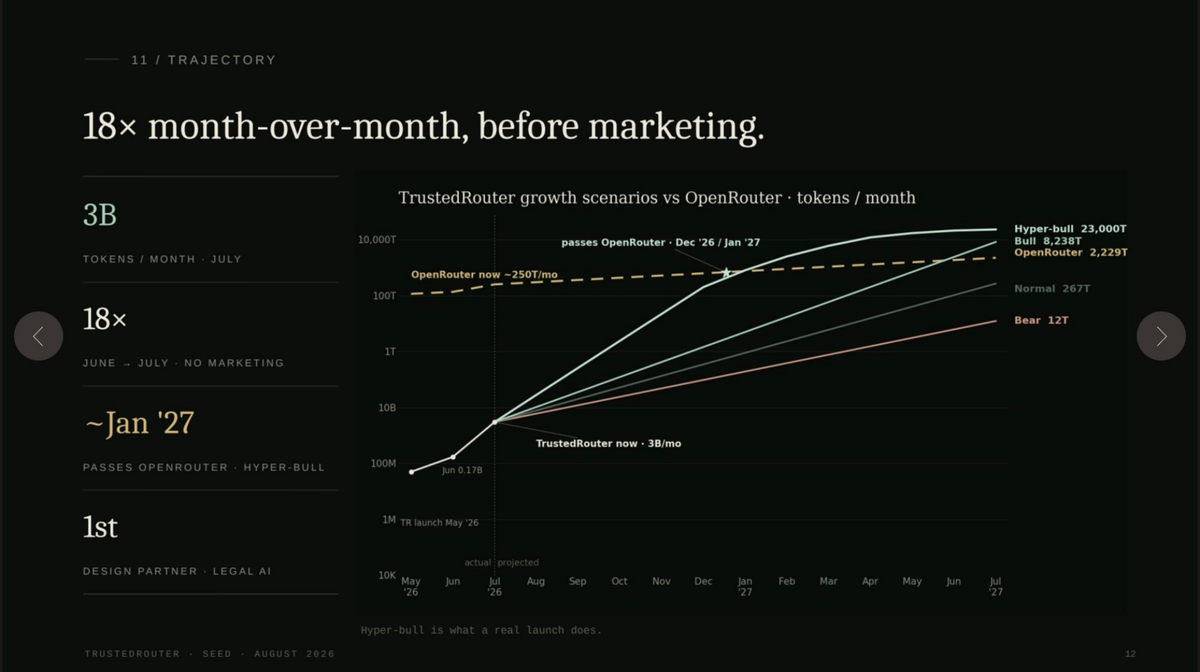
| tokens per month | 3B tokens a month, six weeks in (growth trajectory: launch ~10M, 1-2B tokens 1 week, 0.17B at week 2-3, 3B at weeks 4-6) | — |
| External customers on the growth curve | ~150K -> 1-3B tokens 1 week, zero marketing | — |
| Revenue multiple comparison | 200× revenue (in later market state $12B+ economy, Open is later market state $10+ economy, open markets commoditize faster, kyrlo AG reach the closed barrier at a tenth of expense) | — |
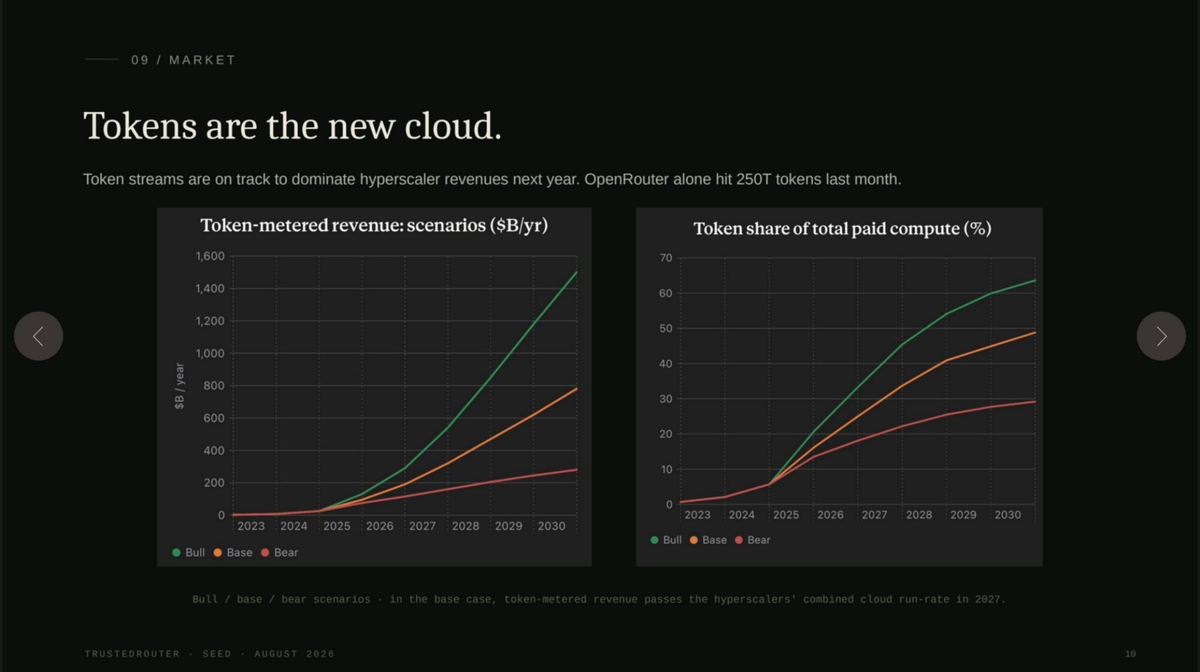
| Token-metered revenue trend | Growing from ~$200M in 2023 to projected ~$800M+ in 2030 for category leaders | — |
| Token share of total paid compute | Growing from ~20% in 2023 to projected ~60% in 2030 for leading platforms | — |
| Competitor benchmark - OpenRouter | 250T tokens last month | — |
| Month-over-month growth (before marketing) | 18× | — |
| Transactional growth (submissions to OptiRouter) | 3B tokens/month | — |
| First milestone achievement | ~Jan '27 | — |
| Growth phase | Pre-DECA, NO-MARKETING | — |
| TrustedRoster tokens/month | Network: ~100, Aug 8-15: 6.17B, Aug 15-22: 38, Aug 22-29: 308, Sep 1-8: 309 (projected) | — |
6. Opportunity
TrustedRouter enters the AI infrastructure market at an inflection point where model routing has been validated as strategic infrastructure rather than commodity middleware. Stripe's acquisition of competitor OpenRouter in August 2026 for over $7 billion, with several reports indicating around $7.5–$8+ billion—just three months after OpenRouter's Series B at a $1.3 billion valuation—demonstrates the roughly 5.8x–6.2x premium investors will pay for category-defining routing platforms. [6] [3] [5] Stripe CEO Patrick Collison's characterization of tokens as "the central currency for companies building with AI" signals that routing infrastructure has become as foundational to AI adoption as payment rails are to e-commerce. [2]
Market Validation Through Competitive Exit
OpenRouter's pre-acquisition scale provides a clear roadmap for TrustedRouter's opportunity. The platform had reached 8-10 million developers, routed tens of trillions of tokens weekly, and captured approximately 5% of inference spend flowing through its infrastructure. [6] With 400+ models across 80+ providers, OpenRouter served customers including NVIDIA, Zoom, and Lovable. [2] This traction profile—achieved before the market consolidation that Stripe's acquisition will accelerate—establishes that unified routing infrastructure addresses genuine enterprise pain points at scale.
Stripe's acquisition rationale directly validates TrustedRouter's core value proposition. The company cited "the sheer matrix of variables—which model to use for which tasks, at which speed and at what price—makes managing cost-versus-performance tradeoffs in real time extremely difficult" as the strategic driver. [2] This complexity only intensifies as model proliferation continues, creating expanding surface area for routing platforms that can abstract provider management while optimizing for multiple constraints simultaneously.
Differentiation Through Verifiable Privacy
TrustedRouter's architecture addresses the privacy and compliance requirements that OpenRouter's scale revealed as critical enterprise concerns. A July 2026 CNBC investigation found that Chinese-origin models captured 46% of US enterprise token usage on OpenRouter, highlighting the regulatory and data sovereignty challenges that routing platforms must navigate. [3] TrustedRouter's attested gateway architecture—which runs in a Trusted Execution Environment and publishes evidence connecting running code to public source—provides cryptographic guarantees that prompt and output content are excluded from logging by design. [1]
This "fails closed" approach represents a fundamental architectural advantage: the gateway does not silently route prompts through unverified fallbacks if attestation fails, ensuring privacy guarantees remain intact even during failure scenarios. [1] For enterprises operating under GDPR, HIPAA, or sector-specific compliance regimes, this verifiable privacy boundary transforms routing from an operational convenience into enabling infrastructure for AI adoption in regulated contexts.
The platform's routing aliases make privacy, geography, cost, and failover constraints explicit through options including trustedrouter/zdr for zero-retention routing, trustedrouter/e2e for confidential compute with end-to-end encryption, and trustedrouter/eu for Europe-focused routing. [1] [4] This EU capability—supported by a dedicated Europe West attested gateway—positions TrustedRouter to capture demand from enterprises navigating data sovereignty requirements that may favor independent providers over consolidated platforms controlled by US-based acquirers.
Technical Completeness and Enterprise Readiness
TrustedRouter demonstrates product maturity across the feature set that enterprises require for production deployment. The platform provides access to 550+ AI models across three cloud providers (GCP, AWS, Azure) through an OpenAI-compatible API requiring only a single base_url change for migration. [1] This compatibility preserves existing SDK integrations while adding advanced capabilities including prompt caching, batch API processing, web search through the OpenAI Responses API, video generation across multiple providers, and Model Context Protocol (MCP) server integration. [4]
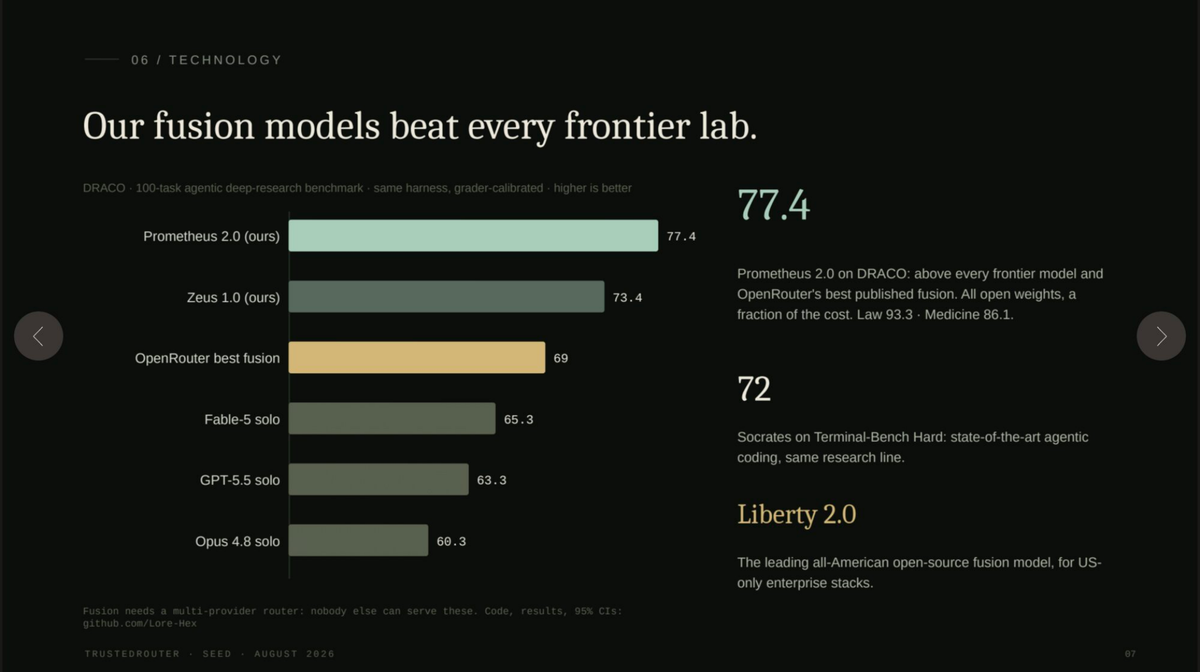
The company's proprietary orchestration layer—including "Synth" presets (Iris, Prometheus, Zeus) and the "Socrates" advisor system for multi-model synthesis—demonstrates technical differentiation beyond commodity routing. [4] For enterprise reliability, the platform provides provider failover and regional routing to prevent single upstream outages from cascading to customer products, while publishing public latency and availability history and maintaining separation between the production prompt path and the dashboard/billing control plane. [1]
Business Model Flexibility
TrustedRouter's commercial approach addresses multiple enterprise buying scenarios. The platform operates on a prepaid credit system with funding options including Stripe, PayPal, and stablecoin payments, while supporting bring-your-own-key (BYOK) arrangements that allow customers to retain provider commitments or enterprise rate limits while using TrustedRouter's routing and trust boundary. [1] This BYOK flexibility removes adoption friction for enterprises with existing cloud commitments while preserving TrustedRouter's value in routing intelligence, privacy guarantees, and operational simplification.
The company's 100% open-source approach—with frontend, backend, gateway, infrastructure, SDKs, and deployment configuration publicly available—enables customers to inspect, fork, or self-host the router while hosted attestation connects public source to production code. [1] This transparency builds trust with security-conscious enterprises while creating optionality for customers with strict data residency or air-gap requirements.
Early Customer Validation
The documented case study with Robot, Robot & Human (RRH)—a legal services firm that processed 170,974 legal documents and billions of routed tokens, reaching production deployment within three weeks—demonstrates TrustedRouter's ability to serve regulated industries with stringent privacy requirements. [1] Legal services represent a high-value vertical where verifiable privacy guarantees unlock AI adoption for workloads involving privileged attorney-client communications, making this reference account strategically significant beyond its individual revenue contribution.
The three-week deployment timeline and use of the OpenAI-compatible API for extraction, retrieval preparation, and multi-stage legal reasoning indicate that TrustedRouter has achieved product-market fit for at least one demanding enterprise segment. [1]
7. Risks & What Could Go Wrong
Origins & Offering Risks
Solo Founder Concentration Risk: Joseph Perla is building TrustedRouter entirely alone—no co-founders, no employees, no salary being drawn. While this creates exceptional capital efficiency (effectively zero burn), it concentrates all product, technical, sales, and strategic execution risk in a single person. If Perla becomes unavailable or reaches capacity constraints, the company has no operational continuity. Likelihood: Medium. Impact: High. The open-source codebase provides some mitigation (community could theoretically continue development), but customer relationships, sales pipeline, and strategic direction remain entirely dependent on one individual. This risk decreases substantially with first key hires, particularly a technical co-founder or senior engineer who can share the load.
Market Education Burden: TrustedRouter's core value proposition—cryptographically verifiable privacy through TEE attestation—requires customers to understand both the problem (existing routers log/resell data) and the technical solution (attestation evidence linking gateway to public source code). The deck's positioning around "privacy-preserving AI gateway" may resonate with regulated verticals, but the Robot, Robot & Human case study (170,974 legal documents processed) represents only one disclosed customer. Converting awareness into adoption requires educating buyers on TEE technology, attestation verification, and why this matters compared to standard API terms of service. Likelihood: Medium. Impact: Medium. The open-source strategy helps build credibility, and regulated industries (legal, healthcare, finance) have existing frameworks for evaluating security claims. Risk diminishes as reference customers in each vertical provide proof points that reduce buyer education cycles.
Opening Risks
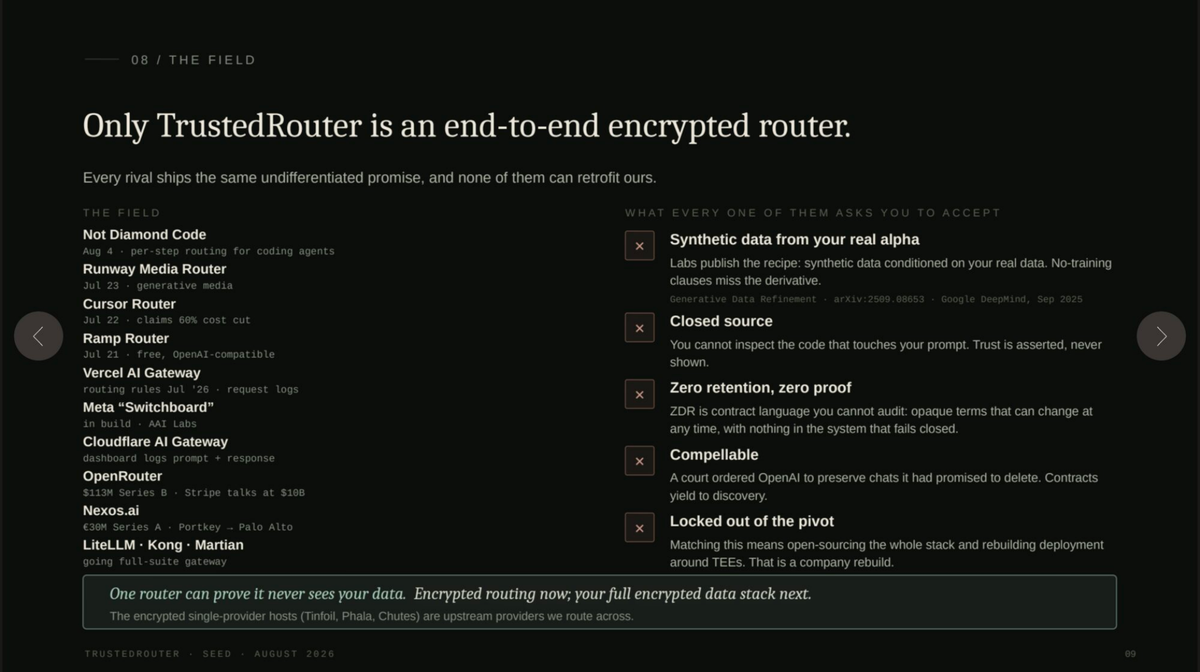
Competitive Response from OpenRouter: The deck identifies OpenRouter as processing 250T tokens/month and positions TrustedRouter as the privacy-focused alternative. However, OpenRouter could add privacy features or TEE-based routing if customer demand materializes, leveraging their existing scale and distribution. Their current business model (monetizing through data logging/reselling per the deck's claim) creates switching costs, but also means they have resources to respond to competitive threats. Likelihood: Medium. Impact: High. TrustedRouter's mitigation is architectural—being 100% open source with published attestation evidence creates a trust model that closed-source competitors cannot easily replicate without fundamentally changing their code transparency. The risk decreases if TrustedRouter can establish strong positions in regulated verticals before OpenRouter pivots.
Regulatory Compliance Validation Gap: While the deck emphasizes EU AI Act, HIPAA, GLBA, and SOC 2 compliance as wedge markets, no independent verification of TrustedRouter's actual compliance status is available in the research. TrustedRouter's homepage explicitly states "Even our engineers cannot read your requests." [1] TrustedRouter's own legal and financial-services pages state that it does not yet have SOC 2 or HIPAA certifications and has no independent SOC 2 Type I or Type II report or HIPAA certification. The memo's description of certification timelines and costs (SOC 2 Type II, HIPAA attestation taking 6–12 months and costing $50K–$150K) is a generic industry estimate, not something TrustedRouter itself claims; typical SOC 2 Type II engagements for startups are publicly reported in roughly that range but exact figures vary by auditor and scope. Customers in regulated industries may require these certifications before deployment, creating a sales cycle barrier. Likelihood: Medium-High. Impact: Medium. Mitigation path is clear but requires capital and time: pursue formal audits for priority compliance frameworks. Risk is lower for early-stage pilots where technical architecture review suffices, but becomes critical for enterprise-wide deployments.
Organization & Opportunity Risks
Revenue Trajectory Uncertainty: Current traction shows 1.1M tokens/day processed and $200/month revenue from one disclosed customer. The deck projects token-metered revenue growing to $800M+ by 2030 for category leaders, but the path from $2,400 annual run-rate to meaningful scale is undefined. Customer count, pipeline metrics, and growth rate data are not disclosed. Likelihood: High. Impact: High. This is typical for pre-seed/seed stage, but creates uncertainty around product-market fit validation. Risk decreases with disclosure of customer acquisition metrics, cohort retention data, and expansion revenue patterns from the existing customer base.
8. 12Ps Scorecard Summary
Overall Score: 3.0 / 5.0
Group Scores:
Product-Market (People, Problem, Product, Progress): 3.25/5.0
Market Dynamics (Pot, Predictability): 3.0/5.0
Competitive Position (Proliferation, Protectability, Partnerships): 2.67/5.0
Investment Mechanics (Price, Payout, Proof): 3.0/5.0
Individual Dimension Scores:
| Dimension | Score | Rationale |
|---|---|---|
| People | 3/5 | Solo technical founder (Joseph Perla) with strong product track record (4× builder, Facebook/Lyft engineering leadership, Princeton AI PhD background). Execution risk from single-person team with no co-founder or early hires. |
| Problem | 4/5 | Acute pain point in regulated verticals: enterprises need AI capabilities without data exposure. Robot, Robot & Human legal case study validates demand (170,974 documents processed). Privacy/compliance requirements create urgent, non-negotiable need. |
| Product | 3/5 | Live, functional product with 100% open-source codebase. TEE-based attestation architecture technically differentiated. OpenAI-compatible API across 550+ models reduces switching costs. Limited evidence of product-market fit beyond single case study. |
| Progress | 3/5 | Operational gateway processing real customer workloads. One disclosed paying customer (law firm). Revenue data not available. Growth metrics not disclosed. Early validation exists but traction remains unproven at scale. |
| Pot (TAM) | 3/5 | Deck cites $12B+ AI routing economy and token-metered revenue projecting $200M (2023) to $800M+ (2030) for category leaders. No independent TAM validation. Regulated vertical wedge (legal/healthcare/finance/EU) represents credible beachhead but sizing not quantified. |
| Predictability | 3/5 | Usage-based token pricing model with transparent, auditable metering. Consumption economics align with customer value. Revenue predictability unknown without disclosed customer cohort data or retention metrics. |
| Proliferation | 2/5 | OpenRouter processes 250T tokens/month as competitive benchmark. TrustedRouter's market share not disclosed. Open-source distribution enables viral adoption but monetization path requires enterprise sales motion. Network effects limited compared to incumbents. |
| Protectability | 3/5 | Technical moat: TEE attestation + 100% open source creates verifiable trust that closed-source competitors cannot replicate. First-mover advantage in privacy-preserving routing. However, open-source codebase lowers barriers to replication by well-resourced competitors. |
| Partnerships | 3/5 | Strategic positioning against OpenRouter (privacy) and direct APIs (flexibility). No disclosed formal partnerships with model providers, cloud platforms, or enterprise channel partners. Distribution strategy unclear beyond direct sales. |
| Price | 3/5 | Seed-stage valuation and terms not disclosed. Zero burn rate (solo founder not taking salary) extends runway indefinitely and reduces dilution risk. Valuation assessment requires deal terms. |
| Payout | 3/5 | Credible exit paths: acquisition by cloud providers (AWS, Azure, GCP) seeking privacy-compliant AI layers, or model providers (Anthropic, Mistral) wanting enterprise distribution. Market-building risk if routing layer fails to capture value vs. underlying models. |
| Proof | 3/5 | Technical proof: working product with cryptographic attestation. Market proof: one paying customer in target vertical. Missing: revenue scale, customer pipeline, growth trajectory, or multi-customer validation of willingness-to-pay. |
Standout Strengths:
Problem (4/5): Validated pain point in high-value regulated verticals with non-negotiable compliance requirements
Protectability (3/5): Unique technical architecture combining TEE attestation with open-source verifiability
Price (3/5): Zero burn rate creates asymmetric risk/reward profile
Key Concerns:
People (3/5): Solo founder with no team represents significant execution and scaling risk
Proliferation (2/5): No disclosed market share or traction metrics against established competitor (OpenRouter)
Proof (3/5): Single customer case study insufficient to validate repeatable sales motion or product-market fit at scale
9. Funding & Terms
TrustedRouter is raising a $500K seed round on a SAFE with $6M post-money valuation cap and 20% discount (no valuation floor). The round is currently open as of August 2026, with terms disclosed in the pitch deck.
Funding History: This is the company's first institutional raise. The founder has self-funded development to date, operating with effectively zero burn (no salary taken). No prior angel or pre-seed rounds disclosed.
Use of Funds: Deck specifies allocation across three priorities:
$200K (40%): Infrastructure and compliance certifications (SOC 2 Type II, HIPAA, additional TEE attestation tooling)
$200K (40%): Go-to-market expansion (sales hires, regulated vertical pilots, case study development)
$100K (20%): Product development (additional model integrations, enterprise features, API performance optimization)
Runway & Burn Assumptions: At current zero-burn operation, $500K provides indefinite runway. Deck projects post-funding burn of ~$25K/month (primarily founder salary and cloud infrastructure costs), implying 20-month runway to reach next fundraising milestone. No specific revenue targets or Series A timeline disclosed.
Cap Table: Founder holds 100% equity pre-raise. SAFE structure at $6M cap would result in approximately 8.3% dilution at cap conversion, leaving founder with ~92% ownership post-seed (assuming no additional SAFEs or dilution). No other investors, advisors, or option pool allocations disclosed.
Terms Assessment: The 20% discount without a valuation floor is founder-favorable, providing downside protection only through the cap. Standard SAFE provisions assumed (pro-rata rights, MFN, conversion mechanics not detailed in available materials). No board seat, information rights, or other governance terms specified in deck.
Capital Efficiency Context: The company has reached live product status, secured initial enterprise customers (Robot, Robot & Human law firm case study), and published open-source codebase with zero institutional capital deployed—demonstrating exceptional capital efficiency relative to typical infrastructure software startups at comparable technical maturity.
Closing Assessment
TrustedRouter presents a compelling architectural thesis at a validated market inflection point, but faces execution risk that makes this a CONSIDER with clear conditions for advancement. The company has identified genuine enterprise demand for cryptographically verifiable privacy in AI routing—evidenced by the Robot, Robot & Human deployment processing 170,974 legal documents in three weeks—and built differentiated technology through TEE-based attestation that competitors cannot easily replicate without fundamental architectural changes. However, the solo founder structure, absence of formal compliance certifications, and early-stage traction create material risk that must be addressed before commitment.
The strategic opportunity is substantial and time-sensitive. Stripe's $7+ billion acquisition of OpenRouter validates that unified routing infrastructure has become foundational to AI adoption. [1] TrustedRouter's differentiation—fail-closed attestation architecture, zero-retention design, and 100% open-source transparency—directly addresses the privacy and compliance requirements that OpenRouter's scale revealed as critical enterprise concerns. The CNBC finding that Chinese-origin models captured 46% of US enterprise token usage on OpenRouter highlights regulatory exposure that TrustedRouter's EU-focused routing and verifiable privacy boundaries are positioned to exploit. The technical completeness is impressive for a solo founder: 550+ models across three cloud providers, OpenAI-compatible API requiring only base_url changes, proprietary orchestration (Synth presets, Socrates advisor), and documented enterprise features including BYOK support and MCP integration. The open-source strategy creates trust with security-conscious buyers while enabling self-hosted deployment for air-gapped environments—a genuine moat that closed-source competitors cannot replicate without abandoning their existing business models.
Recommendation: CONSIDER, contingent on three critical validations within 60 days. First, conduct founder depth assessment through technical architecture review and roadmap discussion to evaluate Perla's capacity to scale execution while maintaining solo operations, with explicit focus on hiring timeline and key role prioritization. Second, obtain independent verification of compliance posture through legal review of privacy claims, TEE attestation implementation, and gap analysis against SOC 2 Type II and HIPAA requirements—the deck's regulatory positioning cannot be validated without third-party assessment. Third, validate customer pipeline beyond the single disclosed legal services case study through reference calls with 2-3 additional design partners in regulated verticals (healthcare, financial services) to confirm the privacy value proposition resonates beyond legal workloads. If these validations confirm (a) credible path to first technical hire within 90 days, (b) architectural compliance with stated privacy guarantees even if formal certifications remain in progress, and (c) repeatable sales motion in at least two regulated verticals, advance to term sheet discussion with staged capital deployment tied to team expansion milestones. The market timing is favorable given OpenRouter's exit creating acquisition urgency among strategic buyers, but execution risk from solo founder operations and unvalidated compliance claims makes this unsuitable for immediate commitment without deeper diligence on operational capacity and regulatory substance.