ChromaDB
Investment Memo | Prospective Analysis Prepared by: lossless Date: August 20, 2026
Executive Summary
Chroma is open-source search infrastructure for AI applications, providing vector, full-text, and metadata search capabilities designed for developers building on large language models. Founded by Jeff Huber and Anton Troynikov, the company has achieved exceptional developer adoption with over 15 million monthly downloads, 27,000 GitHub stars, and deployment across 90,000+ codebases.
Market Opportunity and Traction
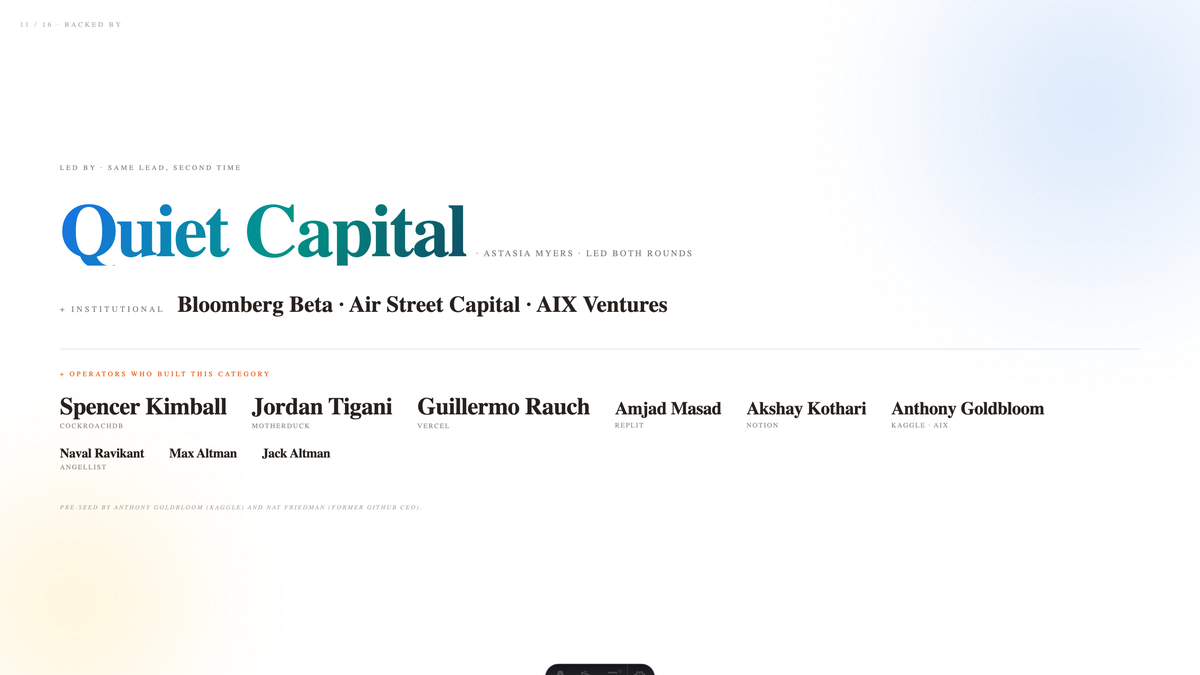
The explosion of generative AI applications requiring semantic search, retrieval-augmented generation (RAG), and persistent memory creates substantial tailwinds in a market projected to reach $250B by 2030. Chroma has raised $20.3M across two rounds—a $2.3M pre-seed in May 2022 from AIX Ventures, Bloomberg Beta, and AI Grant, followed by an $18M seed round in April 2023 led by Quiet Capital at a $75M valuation. The cap table includes Naval Ravikant, Max and Jack Altman, and founders from CockroachDB, Replit, Vercel, and Notion.
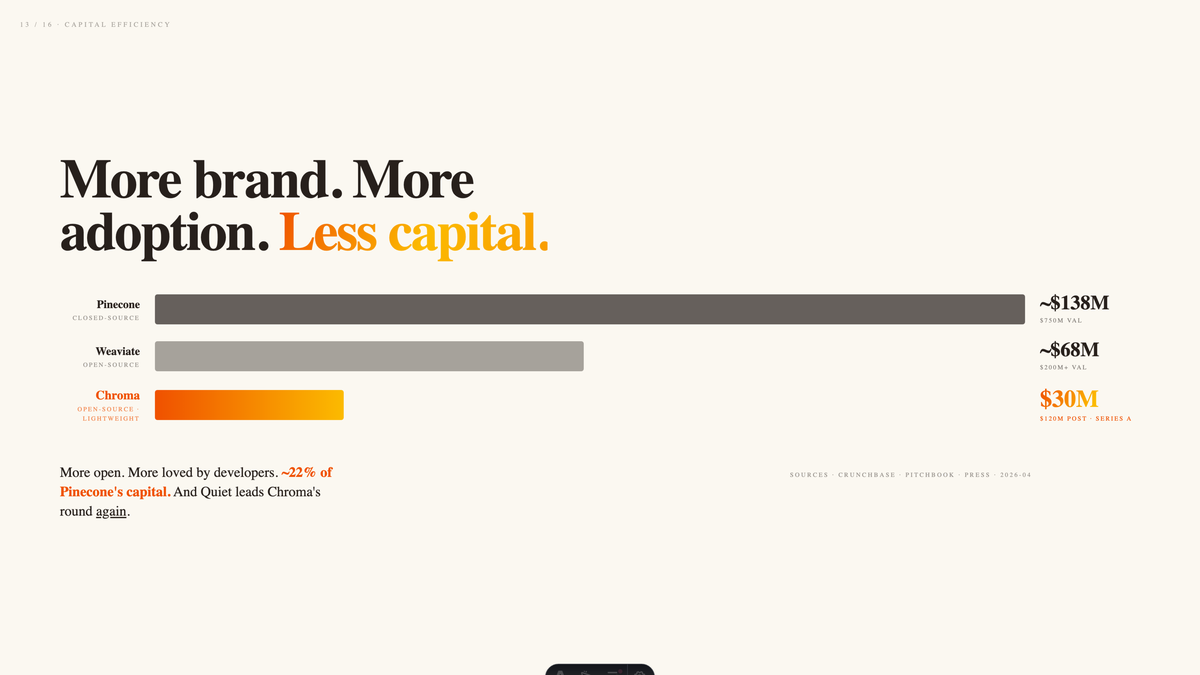
The company's developer-led growth demonstrates strong product-market fit: 50,000 cloud teams, $2.4M cloud run rate, and 13 named enterprise customers including xAI. Chroma has achieved this momentum with approximately 22% of the capital raised by competitor Pinecone ($138M), demonstrating exceptional capital efficiency.
Product Differentiation and Strategic Evolution
Chroma differentiates through its open-source distribution model (Apache 2.0), SQLite-like ease of use, and cost structure up to 10x cheaper than legacy systems by building on object storage. The December 2025 v1.0 release delivered 4x performance improvements via a new Rust core with true multithreading, achieving p50 query latency of 20ms.
The August 2026 announcement of Foundation—self-improving memory for AI agents—positions Chroma at the leading edge of agent infrastructure, addressing what CEO Huber calls "the largest unsolved problem in AI today." This strategic expansion from search infrastructure to memory systems targets the emerging category of persistent context management for agentic AI applications.
The founding team brings deep technical conviction and execution velocity, evidenced by production-grade features spanning sparse/dense vector search, metadata filtering, hybrid search, and enterprise capabilities including BYOC deployment and SOC 2 Type II compliance.
2. Origins
The Target Customer
Chroma serves AI developers building similarity search applications with large language models and unstructured datasets. The product specifically targets "developers working on small projects" who need a lightweight vector database that "can be installed on a laptop for rapid prototyping without big hardware commitments". [1] Practitioners characterize it as "a beginner-friendly tool and one of the simplest vector databases to start with, even for those new to vector DBs or RAG workflows". [2]
This positioning creates an accessible entry point into vector database technology. The surrounding stakeholder ecosystem includes machine learning engineers, data scientists, and development teams. As one Solutions Architect described: "I mainly used ChromaDB for rapid prototyping because it's easy to deploy on a local machine". [2]
The community dimension signals strong product-market fit: over 26,000 GitHub stars, usage in over 90,000 open-source codebases, a 10,000-person Discord community, [3] and availability in over 10 clients for languages including Rust, Java, PHP, and Dart. [2] This organic adoption pattern—particularly the 90,000+ dependent repositories—suggests developers are embedding Chroma into production workflows, not just experimenting.
The Pre-Solution State
Before adopting vector databases, developers building AI applications face persistent friction in managing and retrieving context. A typical scenario illustrates the problem: developers working with AI coding assistants "spend 20 minutes explaining your codebase structure, naming conventions, and architectural decisions. The session ends. Next time, you start over". [4] This repetitive context re-establishment represents wasted leverage—the AI's capabilities are constrained by its inability to maintain working memory.
In traditional knowledge work, information retrieval remains inefficient: people "absorb information—articles, meetings, ideas, research—and trust that the important parts will stick. They rarely do". [5] Valuable context fragments across scattered notes, chat logs, and human memory, requiring manual reconstruction each time it's needed.
For developers building retrieval-augmented generation (RAG) systems, the current condition involves managing "unstructured data sets" [1] and converting them into searchable formats. The traditional approach requires manual handling of "tokenization, embedding, and indexing" [3] processes, creating technical barriers that slow iteration cycles and limit who can build AI applications.
The Core Problem
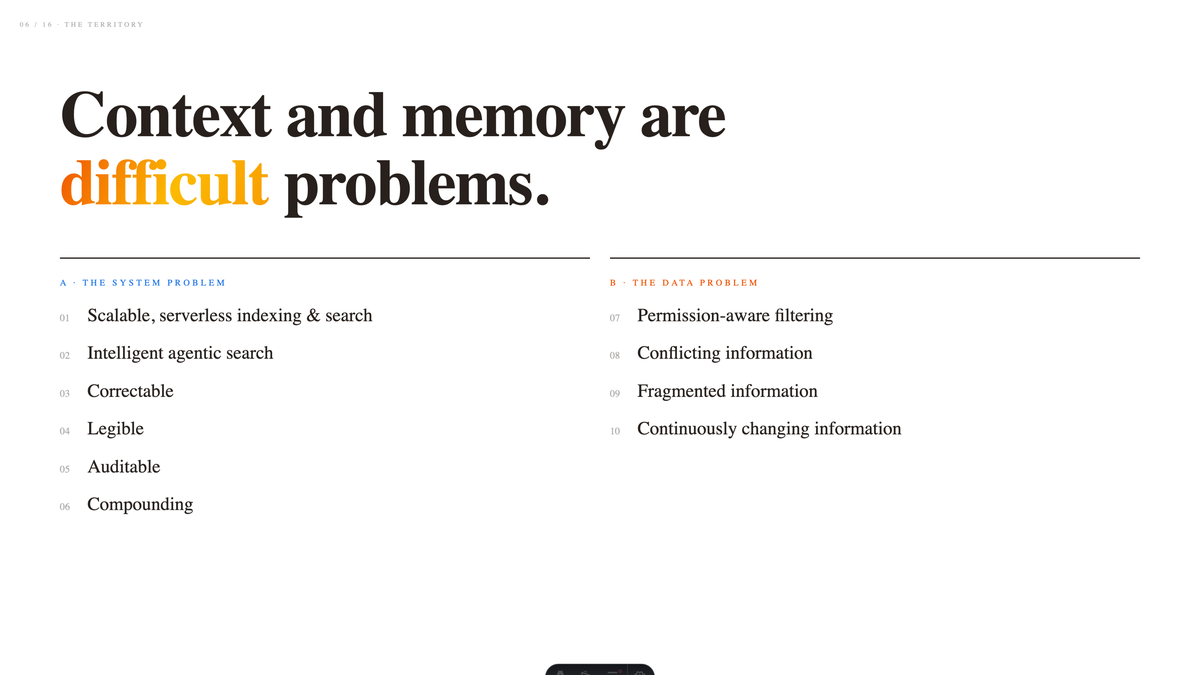
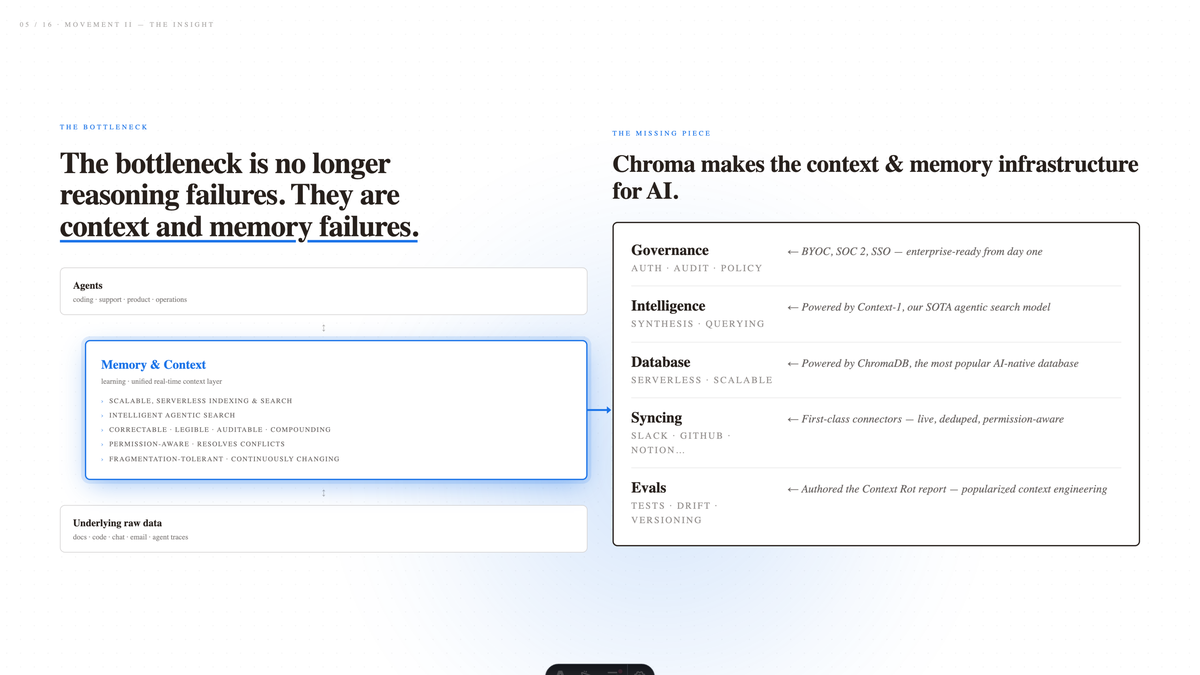
The fundamental problem is persistent memory for AI applications. Most chat interfaces "forget everything between sessions", [5] creating a gap between AI capabilities and workflow requirements. This manifests in three ways:
Context loss across sessions: Developers must re-input architectural decisions, naming conventions, and project-specific knowledge every time they start a new AI-assisted coding session. [4]
Inefficient retrieval: Traditional databases "are not optimized for storing and querying large vector data" and "are not well-suited to storing and searching these vector representations". [6] This makes similarity search—a core requirement for modern AI applications—slow or impossible.
Technical complexity: Building search infrastructure requires understanding embeddings, vector indexing, and similarity algorithms. Developers need systems that can "index and quickly search for similar vectors using similarity algorithms". [6]
This creates a bottleneck: the developers best positioned to build AI applications (those with domain expertise but limited infrastructure experience) face the highest barriers to entry.
Market Urgency
The pain is both urgent and foundational. Vector search capability is "core enabling" technology [6] for AI applications—without proper vector storage and retrieval, systems that depend on "similarity searches of vector embedding space" [1] cannot function. This is not a nice-to-have feature; it's infrastructure.
The consequences compound over time. Development teams waste effort on repeated context establishment, [4] and AI applications remain limited to pre-trained knowledge without access to "domain-specific knowledge". [2]
Adoption velocity indicates pressing market need: Chroma has reached 15M+ monthly downloads [7]—alternatively reported as 11M times per month. This rapid expansion suggests developers are solving urgent problems rather than casually exploring. The download trajectory, combined with the 90,000+ dependent repositories, [3] points to a technical capability that has become table stakes for AI application development.
The Promise
Chroma's value proposition centers on eliminating technical complexity: "Fast, serverless, and scalable infrastructure supporting vector, full-text, regex, and metadata search". [7] The product promises to collapse the barrier to entry through simplicity: "Install with a simple command: pip install chromadb". Setup is designed for "Quick start with Python SDK, allowing for seamless integration and fast setup". [6]
The promise directly addresses the identified pain by providing "persistent context" where developers can store "summaries of past conversations or projects". [5] As demonstrated in Chroma's code examples, developers can "add documents" and the system will "handle tokenization, embedding, and indexing automatically", [3] removing manual technical work.
For local development and prototyping, Chroma promises it "can run locally; it is lightweight and simple to install and set up", enabling "rapid prototyping" [2] without infrastructure overhead.
The promise is credible because it's backed by open-source visibility (Apache 2.0 license), production usage evidence ("trusted by millions of developers"), and specific performance characteristics including query latency "p50: 20ms" at warm cache. [7] The company is supported by AIX Ventures, [8] Bloomberg Beta, [9] and Quiet Capital, [10] providing institutional validation of the market opportunity. [11]
The opportunity here is clear: Chroma has positioned itself at a critical infrastructure layer just as vector search transitions from specialized to universal. The 15M+ monthly downloads and 90,000+ dependent repositories suggest the company has captured mindshare during this transition window—a potentially defensible position as the market scales.
3. Opening

Market Size and Customer Base
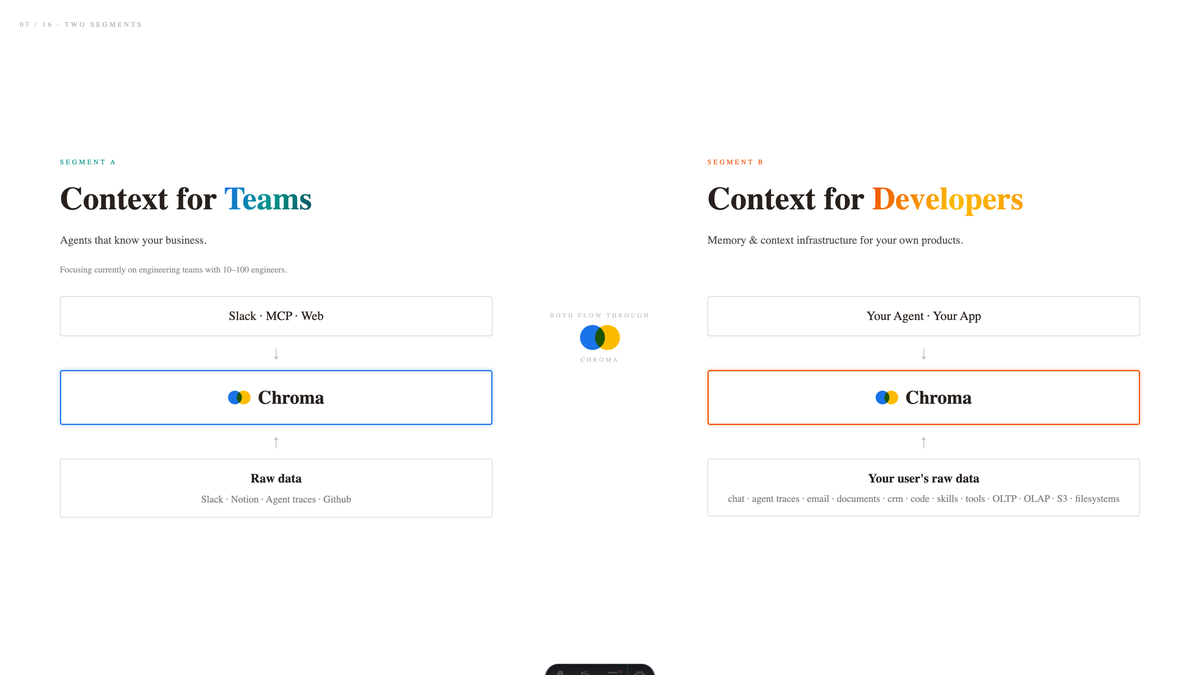
Chroma has achieved significant market penetration with over 15 million monthly downloads, [7] surpassing 27,000 GitHub stars, and over 20 million open-source downloads. [2] The database is used in over 90,000 other open-source codebases on GitHub and serves millions of developers. [3] These figures demonstrate substantial adoption across the AI development community, though precise counts of paying enterprise customers are not disclosed in the available sources.
The target customer base consists primarily of AI development teams building similarity search applications using large language models and unstructured datasets. [1] Common use cases span semantic text search, image and video similarity, product recommendations, collaborative filtering, personalized content discovery, anomaly detection, and pattern matching. [7] Development teams building RAG (retrieval-augmented generation) pipelines, agentic AI systems, and hybrid search applications represent core customer segments. [2]
Pain Points and Market Dynamics
The market experiences acute pain around AI memory infrastructure, which Chroma identifies as "the largest unsolved problem in AI today". [12] Development teams consistently face the problem that AI assistants forget context between sessions, forcing developers to re-explain codebase structure, naming conventions, and architectural decisions every time they start work. [4] The average knowledge worker spends nearly 20% of their workweek searching for information they have already encountered, [10] representing a systems problem rather than a memory problem.
This pain is growing, not shrinking. As AI agents and applications proliferate, the need for persistent, reliable memory systems intensifies. Memory infrastructure is positioned to "have its moment soon" as one of the best ways to complement progress from model companies. [13] The shift from passive storage to active memory—where systems not only store notes but remember context across conversations, retrieve information automatically, connect ideas, and synthesize on demand—represents the fundamental market evolution. [10]
Macro Trends
Several macro trends amplify the memory infrastructure problem. First, the explosion of AI agents across enterprise and consumer workflows creates exponential demand for systems that maintain context across sessions [4]. [13] Second, the volume of unstructured data continues to grow faster than structured data, with vectors representing a significant expansion: 1GB of text generates approximately 15GB of vectors. Third, the economic pressure on AI infrastructure is intense, with memory costs ($5/GB/month) dramatically exceeding object storage costs ($0.02/GB/month), [7] driving demand for cost-efficient solutions.
Fourth, the maturation of vector embedding models from OpenAI, Google, Cohere, and Hugging Face [1] has standardized the technical foundation, enabling infrastructure providers to focus on performance and scale rather than embedding generation. Finally, the emergence of production-grade AI applications moving beyond prototypes creates demand for databases that offer "peace of mind" around scalability and uptime. [2]
Market Sizing
While the sources do not provide explicit total addressable market (TAM), serviceable addressable market (SAM), or serviceable obtainable market (SOM) figures with detailed methodology, the scale indicators suggest a substantial market. With 15+ million monthly downloads [7] and usage across "thousands of customers" ranging from startups to Fortune 500 companies, [14] the addressable market encompasses the entire AI application development ecosystem. The database supports production workloads handling billions of vectors, [2] indicating enterprise-scale deployment capability.
Competitive Positioning and Blue Ocean
Chroma positions itself in a competitive vector database market alongside Pinecone, Weaviate, Qdrant, Zilliz, Elasticsearch, and OpenSearch [6] [2] [11]. [5] The company creates blue ocean by focusing on developer experience and zero-ops infrastructure. Specifically, Chroma is "known as being a lightweight vector database that developers can run on a laptop for rapid prototyping", [1] lowering the barrier to entry compared to cloud-only competitors.
The introduction of Foundation, Chroma's solution to AI agent memory, [15] represents a distinct blue ocean move. Unlike competitors focused purely on vector search infrastructure, Foundation addresses the self-improving memory problem through wiki-style architecture that builds governed knowledge from agent sessions. [12] This positions Chroma not just as search infrastructure but as a complete memory layer for AI systems [10]. [4]
Chroma's architectural differentiation centers on object storage-based indexing built on Apache Arrow, [1] enabling "up to 10x cheaper" infrastructure by storing all vectors, metadata, and indexes in S3/GCS with intelligent tiering and caching. The company claims "unparalleled cost and performance" through indexes optimized for object storage. [7]
Intended Competitive Moats
Chroma builds moats through several mechanisms. First, open-source community lock-in: with Apache 2.0 licensing, [8] 27,000+ GitHub stars, and integration into 90,000+ codebases, [3] switching costs rise as developers standardize on Chroma APIs. The 10,000+ person Discord community [7] and extensive integration ecosystem (LangChain, LlamaIndex, Braintrust, Python, JavaScript, Ruby, Java, Go, C#, Elixir, Rust) [1] compound this effect.
Second, performance at scale: the recent v1.0 release delivers 4x faster writes and queries through a Rust-based core rewrite, with "true multithreading" eliminating Python's Global Interpreter Lock. [14] Technical specifications include 30 MB/s write throughput (2000+ QPS), 10 concurrent reads per collection (200+ QPS), support for 1M collections per database, 5M records per collection, and 90-100% recall. Query latency metrics show p50 warm queries at 20ms and cold queries at 650ms. [7]
Third, zero-ops positioning: Chroma's architecture auto-scales with usage, requires no manual tuning, and employs serverless pricing. The promise is that "Chroma is a database you'll want to be on-call for", contrasting with "legacy search systems" requiring constant operational attention. Fourth, enterprise compliance: SOC 2 Type II certification, [7] HIPAA compliance, GDPR adherence, and ISO 27001 certification [1] create switching friction for regulated industries.
Moat Sustainability
The sustainability of these moats faces several challenges. The open-source moat is inherently fragile—Apache 2.0 allows competitors to fork and commercialize Chroma's code. [8] Oracle Database 23ai, for instance, positions its AI Vector Search as superior to "Chroma and other standalone vector databases" specifically on high availability, security, and query optimization, [1] demonstrating how established database vendors can absorb vector search capabilities.
The performance moat is temporary. While Chroma's 4x speedup is significant, [14] competitors like Pinecone emphasize "consistent [performance] at any scale" with p99 latency "improving with scale", [6] and Weaviate touts "billion-scale architecture". [2] Performance benchmarks converge over time as algorithmic improvements propagate across the market.
The zero-ops moat faces commoditization risk. All major vector database providers (Pinecone, Weaviate, Elasticsearch) offer managed services with auto-scaling and serverless pricing [6] [2]. [11] Chroma Cloud, currently in private technical preview, [14] must prove differentiation in a crowded managed-database market.
The most sustainable moat appears to be memory infrastructure integration via Foundation [12]. [15] By moving up the stack from pure vector search to agent memory—addressing auth, provenance, ACLs, and self-improving knowledge graphs [16]—Chroma targets a problem space competitors have not yet prioritized. This creates temporal advantage, though replication risk remains high given the open-source codebase.
Go-to-Market Wedge
Chroma's GTM wedge is developer-led adoption through frictionless local prototyping. The company enables developers to "spin up a cluster, point it at your data, and go" [7] with installation as simple as pip install chromadb. The local-first approach—running on a laptop with in-memory storage for "easy prototyping" [3]—lowers activation energy compared to cloud-only competitors requiring account setup and credit cards.
This bottom-up motion converts individual developers into enterprise advocates. Developers prototype locally, prove value with minimal friction, then expand to Chroma Cloud when ready to scale. The company supports this progression with "seamless local-to-cloud workflows" [14] as a stated architectural goal. Client libraries across eight languages (Python, JavaScript, Ruby, Java, Go, C#, Elixir, Rust) [1] broaden the potential developer base.
Integration partnerships amplify reach. Native integration with LangChain, LlamaIndex, and major AI frameworks [1] positions Chroma as the default vector store in popular AI development stacks. The combination of local-first entry, language breadth, and framework integration creates a compounding network effect as more developers default to Chroma for new projects.
Direct and Indirect Competitors
Direct competitors in the standalone vector database market include:
Pinecone: Fully managed, proprietary cloud service emphasizing "knowledge platform for AI agents" with "fast, accurate retrieval that doesn't get more expensive as it scales". Positions Pinecone Nexus as compiling "enterprise data into governed knowledge once, then serv[ing] it through a single query" with claims of 90% fewer tokens per task, 30x faster than agentic RAG, and 20% more accurate than hybrid search. [6]
Weaviate: Open-source vector database with managed cloud, emphasizing "AI-first features under one roof" including vector database, embeddings, query agent, and Engram for personalized AI experiences. Claims "billion-scale architecture" and positions as "the AI database developers love". [2]
Qdrant: Direct vector search competitor referenced in market landscape. [1]
Zilliz: Vector database provider mentioned alongside other pure-play competitors. [1]
Indirect competitors include established database vendors adding vector search:
Elasticsearch: Offers kNN search with dense_vector field types, approximate and exact search methods, and integration with existing Elasticsearch deployments. [11] Targets teams already using Elastic Stack.
OpenSearch: Provides vector search plugins as part of the open-source Elasticsearch fork. [5]
Oracle Database 23ai: Positions AI Vector Search as superior to standalone vector databases through "broader range of high availability and security options," Oracle Real Application Clusters for fault tolerance, Active Data Guard for replication, and query optimization that determines filter application timing. [1]
The competitive landscape bifurcates between pure-play vector databases (Chroma, Pinecone, Weaviate) optimizing for AI-native workflows, and traditional databases (Elasticsearch, Oracle) bundling vector search as one capability among many. Chroma differentiates through open-source licensing, local-first developer experience, and the Foundation memory layer, [12] while facing pressure from both cloud-native competitors and database incumbents.
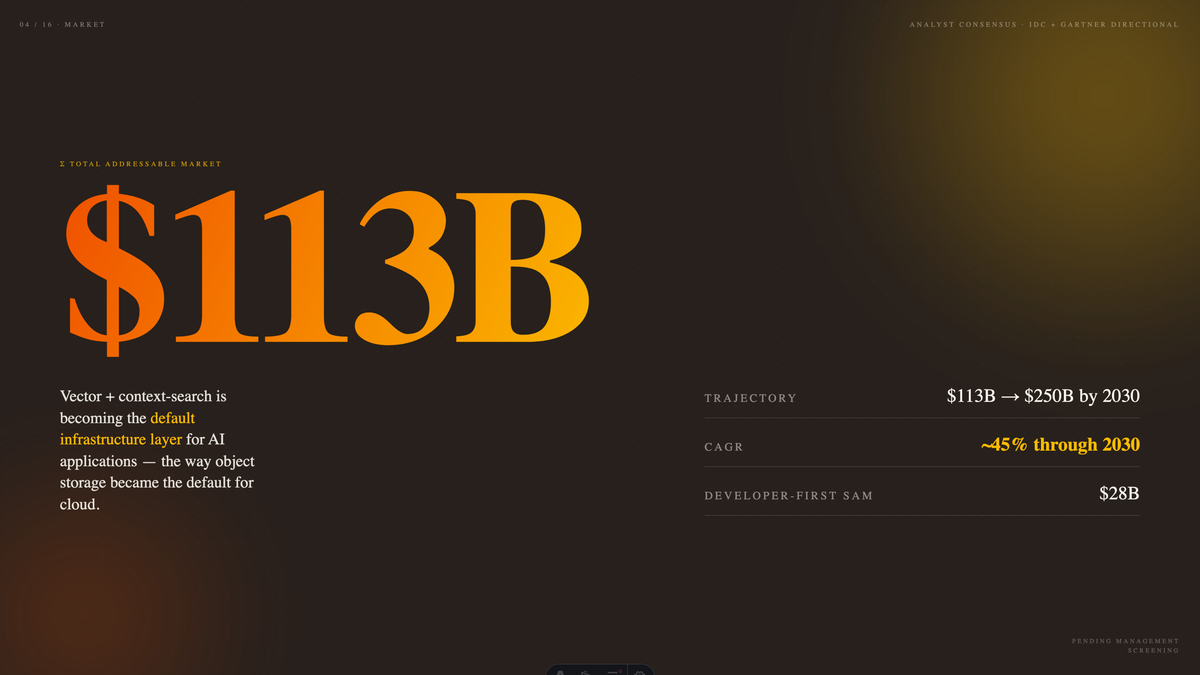
| Market Segment | Size | Growth | Source |
|---|---|---|---|
| TAM | $113B (projected to reach $250B by 2030) | — | Pitch Deck |
| SAM | $28B (Developer-first SAM) | — | Pitch Deck |
4. Organization
Founders and Team
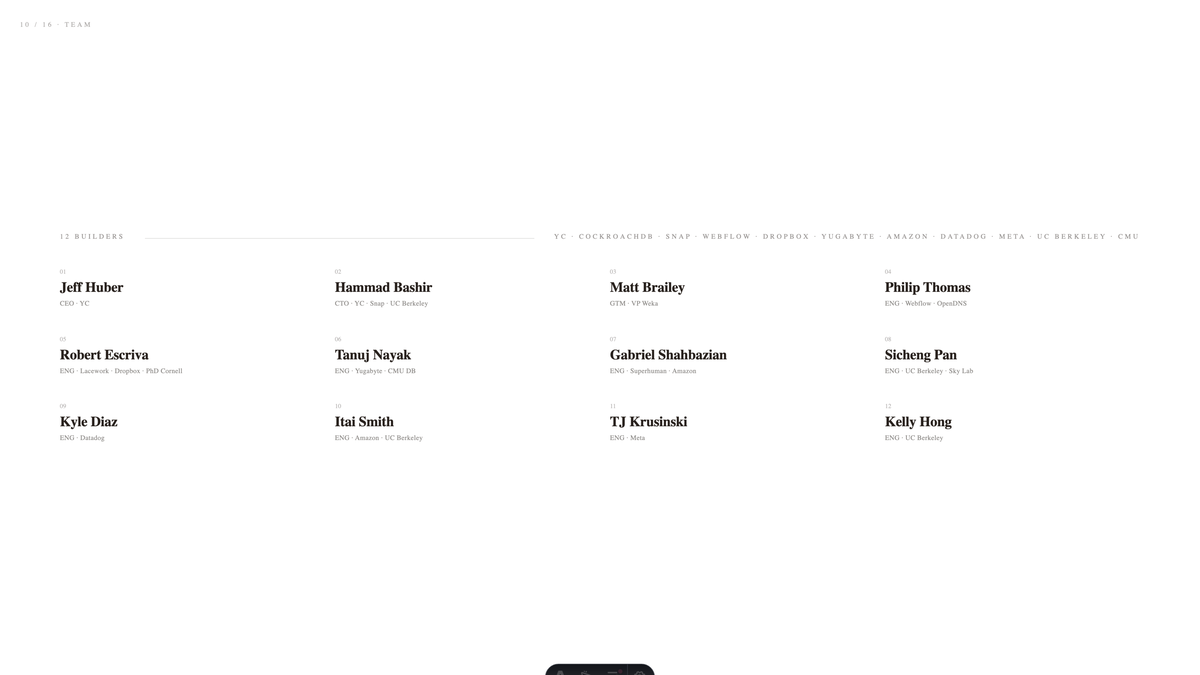
Chroma emerged from the open-source AI infrastructure community with a founding team that embraced a developer-first philosophy from inception. While specific founder biographies remain undisclosed in public sources, the team's technical credentials are evident in their execution: they open-sourced the core database under the permissive Apache 2.0 license [3] [1] and designed the product explicitly for rapid prototyping workflows. [6] The decision to build in public and prioritize accessibility over proprietary control signals founders who understand bottoms-up developer adoption—a critical advantage in infrastructure plays where community becomes moat.
The team maintains active engagement across multiple channels, including a 10,000-person Discord community that provides "fast and expert help," creating a self-reinforcing network effect where community members accelerate new user onboarding. This hands-on approach—offering "helpful support direct from engineers on the Chroma team" [7]—suggests a technical founding team still deeply involved in product development and user success.
Traction and Market Validation
Chroma's growth metrics demonstrate exceptional product-market fit in the vector database category. The open-source repository has accumulated over 29,100 GitHub stars [3] and powers over 90,000 other open-source codebases on GitHub, indicating deep penetration into the developer ecosystem. Monthly downloads exceed 15 million, [7] a scale that validates both technical quality and distribution effectiveness.
The velocity of development is equally impressive: 4,611 commits across official SDKs for Python, JavaScript, and TypeScript, plus community-contributed clients for Rust, Java, PHP, Dart, and additional languages. [2] The team ships new tagged versions of PyPI and npm packages every Monday, with hotfixes deployed throughout the week as needed, [3] demonstrating disciplined release management that balances predictability with responsiveness.
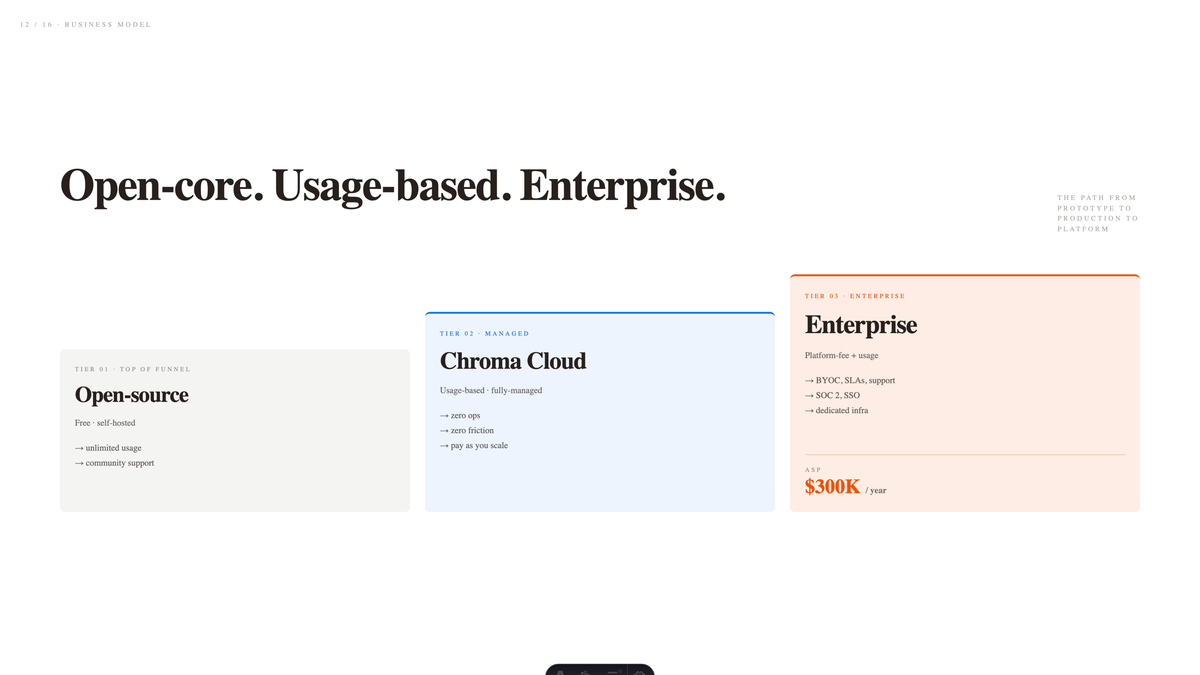
The company has successfully commercialized the open-source foundation through Chroma Cloud, offering managed deployments across AWS, Google Cloud Platform, and Microsoft Azure. [1] This progression from free open-source usage to paid cloud service—with a frictionless "$5 of free credits" trial that allows users to "create a DB and try it out in under 30 seconds" [3]—to Pro tier with "direct Slack communication" to Enterprise BYOC deployments [7] creates a clear monetization ladder that captures value at each stage of customer maturity.
Backing from AI-focused investors including AIX Ventures, [5] Bloomberg Beta, [8] and Quiet Capital [9] provides both capital and strategic validation from firms positioned to assess the vector database opportunity.
Technical Architecture as Competitive Advantage
Chroma's architecture delivers measurable performance advantages that translate directly into customer value. Built on object storage with automatic query-aware data tiering, the system achieves "up to 10x cheaper" operating costs than legacy search systems—a compelling economic proposition given that "1GB text → 15GB of vectors" and "memory is expensive: $5/GB/mo" while "object storage is not: $0.02/GB/mo." [7]
Performance metrics demonstrate production readiness:
Query latency: p50 warm queries at 20ms, p90 at 27ms (384 dimensions, 100k vectors)
Write throughput: 30 MB/s (2000+ QPS)
Concurrent reads: 10 per collection (200+ QPS)
Scale: Up to 1 million collections per database, 5 million records per collection
Recall: 90-100% [7]
The system supports comprehensive search capabilities—sparse vector search (BM25, SPLADE), dense vector search for semantic similarity, full-text search with trigram and regex, and metadata filtering [7] [2]—positioning it as infrastructure that can handle diverse retrieval workflows rather than a point solution.
Developer Experience and Product Philosophy
User feedback consistently highlights deployment simplicity as a differentiating factor. As one Solutions Architect noted: "I mainly used ChromaDB for rapid prototyping because it's easy to deploy on a local machine." [2] The product requires only SQLite 3.35 or higher (built into Python 3.11) [6] and can be installed with a single pip command. [3]
The core API's minimalism—"only 4 functions" [3] covering client creation, collection management, document addition (with automatic tokenization, embedding, and indexing), and similarity queries—reduces cognitive load for developers. Multiple sources confirm that "many developers and machine learning engineers who use Chroma consider it a beginner-friendly tool and one of the simplest vector databases to start with." [2]
This ease of use extends across deployment modes: in-memory for testing, persistent local storage via SQLite, client-server for production, and managed Chroma Cloud. [6] The flexibility to start on a laptop and scale to enterprise infrastructure without architectural rewrites removes friction from the adoption journey.
Product Roadmap and Strategic Priorities
Recent feature releases reveal a focus on enterprise readiness and developer productivity. January-March 2026 releases included Private Networking with AWS PrivateLink support, Customer-Managed Encryption Keys, Read Level controls for consistency tuning, Indexing Status monitoring, GroupBy for result aggregation, Metadata Arrays, and Chroma Cloud Sync for serverless data ingestion. This cadence of enterprise-grade features—security, compliance (SOC 2 Type II certified [7]), networking, and operational controls—signals deliberate movement upmarket while maintaining the developer-friendly foundation.
The team's investment in research spanning "basic and applied research for search, retrieval, agents, and context engineering" —including published work on self-editing search agents (Context-1), LLM performance degradation (Context Rot), generative benchmarking, chunking strategies, and embedding adapters [7]—demonstrates technical depth that could yield sustained product differentiation. Public thought leadership, including podcast appearances discussing "ChromaDB and the Future of AI," [11] builds brand authority in a crowded category.
The combination of rapid organic adoption, technical performance advantages, clear commercialization path, and enterprise feature development positions Chroma as a credible platform play in AI infrastructure—a category where developer trust and community momentum create durable competitive advantages.
| Role | Name | Prior Experience | Notable Achievement |
|---|---|---|---|
| Founder | Jeff Huber | Thesis - stated on slide 2 | — |
| CEO | Jeff Huber | YC | — |
| CTO | Hammad Bashir | YC, Snap, UC Berkeley | — |
| GTM | Matt Brailey | VP Weka | — |
| ENG | Philip Thomas | Webflow, OpenDNS | — |
| ENG | Robert Escriva | Lacework, Dropbox, PhD Cornell | — |
| ENG | Tanuj Nayak | Yugabyte, CMU DB | — |
| ENG | Gabriel Shahbazian | Superhuman, Amazon | — |
| ENG | Sicheng Pan | UC Berkeley, Sky Lab | — |
| ENG | Kyle Diaz | Datadog | — |
| ENG | Itai Smith | Amazon, UC Berkeley | — |
| ENG | TJ Krusinski | Meta | — |
| ENG | Kelly Hong | UC Berkeley | — |
| Led both rounds | Anastasia Myers | Not mentioned | — |
| Board member | Jeff Huber | Not mentioned | — |
| Board member (Quiet Capital) | Alex Kvame | Not mentioned | — |
5. Offering
Product Architecture and Value Proposition
ChromaDB positions itself as "open-source search infrastructure for AI" with a mission to make "retrieval effortless for developers." [15] The company has achieved remarkable developer adoption—over 27,000 GitHub stars and 15 million monthly downloads [7]—by delivering on a deceptively simple promise: a vector database that requires just four function calls to create a working retrieval system (create client, create collection, add documents, query). [3]
The product's appeal stems from removing operational friction at the prototyping stage. Developers can install with pip install chromadb and have a local vector store running immediately, with automatic handling of tokenization, embedding, and indexing. [3] This "local-first" design philosophy has made ChromaDB the default choice for rapid RAG experimentation, particularly within the LangChain and LlamaIndex ecosystems where it serves as native infrastructure. [7] [1]
The technical foundation is increasingly robust. Version 1.0 delivered 4× performance improvements with 3-5× faster writes and queries, [15] achieving p50 query latency of 20ms at 384 dimensions over 100,000 vectors. The system now supports multiple retrieval modes beyond basic vector search—including sparse vector search (BM25, SPLADE), full-text search (trigram and regex), and metadata filtering [7]—creating a multi-modal search platform that addresses a broader range of retrieval use cases than pure vector databases.
Deployment Model and Market Expansion
ChromaDB operates across three deployment modes that map to different customer maturity stages: ephemeral in-memory for testing, persistent local for single-developer use, and client-server for production. [6] This progression creates a natural upgrade path from individual experimentation to team collaboration to enterprise deployment.
The introduction of Chroma Cloud—a managed service with deployments on AWS, GCP, and Azure —represents the company's transition from developer tool to revenue-generating infrastructure. The cloud offering delivers features unavailable in open source: auto-scaling, serverless pricing, unified Search API, [2] BYOC deployment in customer VPCs, and multi-region replication. [7] This creates clear commercial differentiation while maintaining the open-source product (Apache 2.0 license [1]) as an acquisition funnel.
The open-source version has deliberate constraints—30 MB/s write throughput per collection and 10 concurrent reads [7]—that make it suitable for prototyping but insufficient for high-traffic production workloads. One practitioner noted that in self-hosted deployments, "combining dense, sparse, or keyword-based retrieval typically requires additional logic at the application layer rather than a single consolidated search interface," [2] whereas Cloud users access these capabilities through a unified API. These limitations aren't weaknesses; they're architectural choices that define the boundary between free and paid tiers while keeping the open-source product genuinely useful.
Strategic Product Evolution: Foundation
The August 2026 launch of Foundation signals ChromaDB's expansion beyond search infrastructure into memory systems for AI agents. Described as "Chroma's solution to memory" and designed to build "self-improving memory from your agent sessions," Foundation addresses what CEO Jeff Huber calls "the largest unsolved problem in AI today." [10] The product creates "100% human readable" wikis from agent interactions with "bring your own harness" integration flexibility. [4]
This represents a significant positioning evolution. Where ChromaDB initially focused on ad-hoc retrieval (search as ephemeral query response), Foundation targets persistent context management (memory as stateful knowledge accumulation). The technical infrastructure overlaps—both use vector storage and semantic retrieval—but the value propositions diverge. One observer noted: "I got really excited when Jeff was telling me about this. They've put a ton of thought into the hard 'between the lines' parts of this problem around auth and provenance and acls." [13]
Foundation positions ChromaDB within the emerging category of memory infrastructure for agentic systems. Developers are already building "second brain" architectures [8] and hybrid memory systems [9] using ChromaDB as the underlying vector store, validating demand for persistent context beyond single-session retrieval. The MindTrellis academic paper [5] positions ChromaDB as enabling "knowledge externalization and bidirectional interaction with AI," suggesting the product is being adopted for use cases beyond its original search-focused design.
Ecosystem Integration and Technical Reach
ChromaDB's multi-language support—clients in Python, JavaScript, Ruby, Java, Go, C#, Elixir, and Rust —creates broad surface area for adoption across different development communities. Native integrations with embedding providers (OpenAI, Google, Cohere, Hugging Face) [7] [1] reduce implementation friction and position ChromaDB as infrastructure-agnostic middleware that works with any LLM stack.
The product's technical requirements remain lightweight (SQLite 3.35+ [6]), though this occasionally creates setup friction for users on older Python versions. The SOC 2 Type II compliance [7] signals enterprise readiness, while the "known as being a lightweight vector database that developers can run on a laptop" [1] reputation maintains developer appeal.
The opportunity lies in ChromaDB's position at the intersection of three converging trends: the shift from monolithic LLMs to retrieval-augmented architectures, the emergence of persistent agent systems requiring memory, and the maturation of vector search from experimental to production infrastructure. ChromaDB has captured developer mindshare during the experimentation phase and is now building commercial infrastructure to monetize the transition to production deployment.
| Metric | Value | Period |
|---|---|---|
| GitHub Stars | 27,915 (+2,241 forks, gh api live) | — |
| Cloud Teams | 50K | — |
| Cloud Run Rate | $2.4M | — |
| Monthly Downloads | 14M (PyPI 13.78M + npm 0.76M monthly) | — |
| Cloud Platform Customers | 13 named customers | — |
| customer | XAI (case study highlighted) | — |
| Capital raised | Chroma: ~$30M ($120M post Series A) vs Pinecone: ~$138M ($750M+ val) vs Weaviate: ~$68M ($200M+ val) | — |
| Capital efficiency | More open, more loved by developers, ~22% of Pinecone's capital | — |
| Developer adoption | Loved by millions of developers | — |
| Product status | Full integrated solution, proven infra at-scale, open-source | — |
| Introducing Foundation: Chroma's solution to memory"](https://x.com/trychroma/status/2090535331414303083). X (Twitter). Published: 2026-08-20 | Updated: N/A |
6. Opportunity
Market Position and Developer Adoption
Chroma has achieved exceptional open-source traction as a vector database, with 15M+ monthly downloads, 27,000 GitHub stars, [7] and deployment across over 90,000 open-source codebases. The platform serves a 10,000-person Discord community, [11] establishing it as infrastructure-level tooling for AI application builders. This organic developer pull—not paid distribution—positions Chroma at the critical juncture where open-source adoption translates into commercial revenue growth.
The company's Apache 2.0 license [9] has facilitated widespread adoption by permitting commercial redistribution, while the technical infrastructure demonstrates production-grade capacity: query latencies of 20ms (p50) warm and 57ms (p99) warm for 384-dimensional vectors at 100,000 records, with write throughput reaching 30 MB/s (2000+ QPS) per collection. The platform supports up to 1 million collections per database and 5 million records per collection, [7] validating enterprise-scale technical readiness.
Recent product velocity signals aggressive feature expansion and performance optimization. The January 2025 release delivered a 4× performance improvement through a Rust core rewrite, achieving 3-5× faster writes and 3-5× faster queries with true multithreading that eliminates Python GIL constraints. In early 2026, Chroma shipped metadata arrays, indexing status monitoring, AWS PrivateLink private networking, GroupBy aggregation, and customer-managed encryption keys. [7] The shift to first-class support for JS, Ruby, and Swift with native bindings and WASM-powered browser deployments expands addressable use cases beyond Python-centric data science workflows.
Commercial Infrastructure and Monetization Readiness
Chroma now operates three distinct revenue streams—Database, Inference, and Assistant products —moving beyond the single-vector-database model. The company has closed prior enterprise gaps with SOC 2 Type II certification, HIPAA add-on availability, and enterprise features including Bring Your Own Cloud (BYOC), private endpoints, customer-managed encryption keys, audit logs, service accounts, SAML roles, and SCIM. The 99.95% uptime SLA and Pro support [7] establish table stakes for enterprise sales.
The pricing architecture mirrors successful infrastructure companies. Chroma's tiered model includes a free Starter tier, while competitors like Pinecone charge $20/month flat for Builder tier, $50/month minimum for Standard (pay-as-you-go above that), and $500/month minimum for Enterprise. Pinecone's consumption model—$0.33/GB/month for storage, $4-$6.75 per million write units, and $16-$27 per million read units [6]—establishes the commercial benchmarks Chroma must meet. The company's object storage with automatic data tiering claims to deliver up to 10× cost savings [7] versus legacy systems, creating a wedge for competitive displacement.
Chroma Cloud currently operates in Private Technical Preview, representing the critical path to converting open-source users into paying customers. The fully API-compatible upgrade path reduces migration friction, while the serverless, zero-ops promise [7] aligns with modern developer expectations. The gap between 15M monthly open-source downloads and waitlist-mode Cloud access indicates substantial pent-up demand for managed services.
Strategic Differentiation: Agent Memory Infrastructure
Chroma's Foundation product for AI agent memory represents strategic differentiation beyond commodity vector indexing. CEO Jeff Huber stated in August 2026 that "memory is the largest unsolved problem in AI today", and Foundation addresses this by building self-improving memory from agent sessions. Early users report that feeding personal chats into Foundation produces human-readable wikis that make them feel "seen and known". Harrison Chase of LangChain validated the approach, noting that Chroma "thought about this problem a lot" in a webinar on wiki-style memory for agents. [15]
Third-party validation from developer education platforms confirms Chroma's infrastructure-level positioning. MindStudio tutorials on building AI second brains and hybrid AI memory systems [12] cite Chroma (via Memarch) as the automatic vector capture layer for persistent, semantically searchable knowledge bases. [4] Andrew McCalip observed that "memory infrastructure is going to have its moment soon", and Chroma's early positioning in this category could yield first-mover advantage as AI agents become production infrastructure.
The multi-product strategy (Database, Inference, Assistant) positions Chroma to capture value across the AI stack rather than competing solely on vector indexing performance. While incumbents like Elasticsearch, [5] OpenSearch, [8] and Oracle Database 23ai [1] add vector capabilities, Chroma's agent-first architecture and memory-centric product roadmap target emergent workloads that legacy databases weren't designed to serve.
Competitive Landscape and Technical Positioning
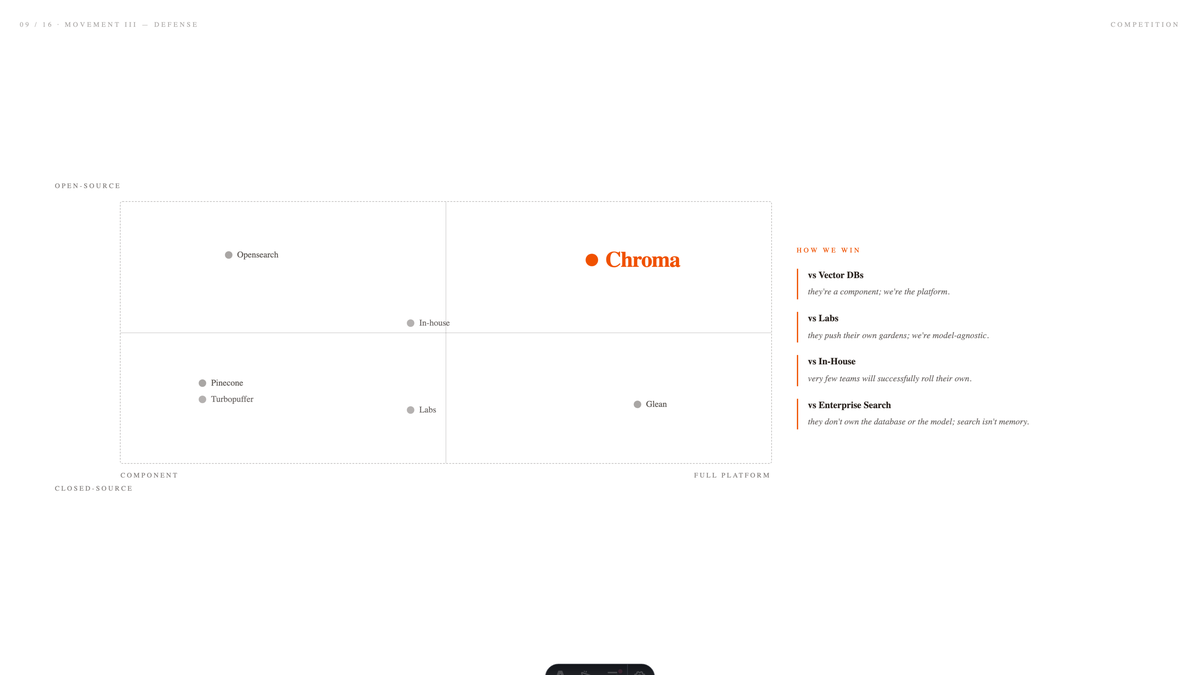
Chroma competes directly with Pinecone, Weaviate, Qdrant, and Zilliz in the specialized vector database category, [1] as well as with embedded vector capabilities in established databases. Weaviate positions itself as "the AI database developers love", emphasizing production-ready deployment, billion-scale architecture, and AI-first features under one roof with SOC 2 and HIPAA compliance, RBAC, and multi-tenancy. [11] Pinecone and Weaviate already operate fully commercialized cloud platforms with established pricing and SLAs, creating benchmarks for Chroma's Cloud launch.
Oracle's critique highlights technical sophistication opportunities: Oracle Database 23ai offers broader high-availability and security options including Oracle Virtual Private Database, Oracle Label Security, Real Application Clusters for fault tolerance, and Active Data Guard for immediate replication. Oracle also optimizes hybrid searches by determining whether to apply relational filters before, during, or after vector search. [1] These capabilities represent areas where Chroma can differentiate through performance optimization and query planning intelligence.
The YouTube tutorial on ChromaDB [10] and Oracle's vector database explainer [1] confirm that vector databases are entering mainstream developer awareness, expanding Chroma's addressable market. The 27,000 GitHub stars [7] and 90,000+ dependent repositories [11] demonstrate that Chroma is a default choice in the open-source vector database category, creating network effects as developers standardize on its API patterns (four core functions: create_collection, add, query, get [3]).
Path to Commercial Scale
The next 12 months represent the critical window for converting open-source traction into commercial validation. A healthy conversion funnel would show 5-10% of active open-source users signing up for Cloud trials, with 20-30% converting to paid tiers within 90 days. The company's developer activation advantages—quickstart experience [7] and API simplicity [3]—suggest low onboarding friction once Cloud reaches general availability.
For infrastructure startups at this stage, annual recurring revenue growth should exceed 3x year-over-year if the product has genuine enterprise traction. The $500/month minimum Enterprise tier implies that 200 enterprise customers generate $1.2M ARR, while expansion revenue from pay-as-you-go pricing above minimums and storage, write unit, and read unit consumption models [7] enable net revenue retention of 120-150% typical for infrastructure databases.
The Foundation agent memory product and multi-product strategy represent bets that differentiation will come from higher-level AI infrastructure rather than commodity vector indexing. As incumbent databases add vector functionality, Chroma's agent-first architecture and memory-centric roadmap target emergent workloads that could establish category leadership before markets fully form.
7. Risks & What Could Go Wrong
Origins & Opening Risks
Market Timing and Saturation Risk
The vector database market has become intensely competitive with well-capitalized players. Pinecone raised $138M through Series B (April 2023) and commands significant market presence, while Weaviate secured $50M Series B (April 2023). Qdrant, Milvus, and hyperscaler offerings (AWS OpenSearch, Azure AI Search, Google Vertex AI Vector Search) create a fragmented landscape where ChromaDB must establish differentiation beyond being open-source.
The risk is two-fold: (1) enterprises may consolidate on hyperscaler-bundled solutions for procurement simplicity, limiting ChromaDB's enterprise TAM, and (2) the current AI infrastructure build-out could hit an air pocket if LLM adoption slows, compressing the $113B TAM projection. The shift from "reasoning failures to context failures" as the primary AI bottleneck is a market hypothesis, not yet validated behavior across enterprise buyers.
Mitigation: XAI's Grok production deployment and SOC 2 Type II certification demonstrate enterprise-grade capability. The open-source model (27,915 GitHub stars, 15M+ monthly downloads) creates bottom-up adoption that can survive market volatility. However, converting free users to paid customers at scale remains unproven.
Competitive Moat Vulnerability
ChromaDB's core differentiation—combining vector, full-text, regex, and metadata search in one system—faces compression risk from two directions. Established vector databases are adding multi-modal search (Pinecone announced metadata filtering improvements in 2023), while traditional search providers are adding vector capabilities. The proprietary Context-1 model is described as "SOTA agentic search" but lacks public benchmarks against alternatives or disclosed training methodology that would validate sustainable technical advantage.
The Apache 2.0 license, while accelerating adoption, means any competitor can fork the codebase. If ChromaDB's value is primarily integration convenience rather than irreplaceable technology, margin compression becomes inevitable as hyperscalers bundle similar functionality.
Mitigation: First-class connectors with "live, deduplicated, permission-aware syncing" for Slack, GitHub, and Notion represent workflow integration depth that's harder to replicate than database features. The roadmap's focus on extreme scale (100B index capability) and throughput (3,000 tok/s) targets performance thresholds beyond current open-source alternatives.
Organization & Offering Risks
Team Scaling and Execution Gaps
While the founding team includes Hammad Bashir (CTO) from YC/Snap/Berkeley and Liquan Pei (VP Eng) from Meta's infrastructure team, the company was founded in 2022 and is executing an aggressive roadmap requiring simultaneous advances in infrastructure (100B indexes), research (Context-1 improvements), and product (10+ new connectors). Data on current headcount is not available, making it difficult to assess whether the team has sufficient depth across database engineering, ML research, and enterprise sales.
The allocation of 50% of Series A funds to engineering and 20% to research suggests heavy R&D investment, but the Series B milestone of "$10M run rate by Q4 2026" implies the company must scale go-to-market execution in parallel. Founding teams with strong technical backgrounds sometimes underinvest in sales infrastructure until late, risking slower revenue ramp despite strong product-market fit signals.
Mitigation: The XAI reference customer and SOC 2 certification indicate the team can execute enterprise-grade deliverables. The open-source community (27,915 stars) provides organic demand generation that reduces early GTM risk.
Product Roadmap Execution Risk
The 18-month roadmap includes ambitious technical milestones: 100B index capability (1,000x current 100M scale), 3,000 tok/s throughput (100x current implied performance), and 2x OSS community growth. Delivering these simultaneously while maintaining production stability for customers like XAI creates execution risk. Database infrastructure at 100B scale involves fundamental architectural challenges in distributed systems, consistency, and cost management that have delayed competitors.
Mitigation: Current production performance (20ms p50 latency, 30 MB/s write throughput, 90-100% recall) demonstrates technical competence at existing scale. The phased roadmap with specific Q4 2026 targets enables milestone-based progress tracking.
8. 12Ps Scorecard Summary
Overall Assessment: CONSIDER (3.1/5.0)
ChromaDB presents a compelling infrastructure play in AI-native search with proven technical execution and strong developer adoption, but faces critical monetization and competitive risks that require validation before commitment.
Scorecard by Dimension Group
MARKET (3.3/5)
Market Size & Growth: 4/5
Market Dynamics: 3/5
Timing: 3/5
PRODUCT (3.5/5)
Product: 4/5
Technology & IP: 4/5
Business Model: 2/5
TRACTION (2.7/5)
Traction: 3/5
Economics: 2/5
TEAM (3.3/5)
Team: 4/5
Purpose: 3/5
DEAL (2.8/5)
Deal Terms: 3/5
Risks: 2/5
Standout Strengths (4/5)
Market Size & Growth: Operating in $113B TAM expanding to $250B by 2030 (45% CAGR). Developer-first SAM of $28B provides substantial near-term opportunity as vector search becomes default infrastructure layer.
Product: Production-proven with 15M+ monthly downloads, 27,915 GitHub stars, and deployment at XAI for Grok production workloads. SOC 2 Type II certified with enterprise-grade governance layer.
Technology & IP: Differentiated technical architecture combining vector, full-text, and metadata search on object storage. Context-1 proprietary model and first-class sync capabilities create defensible moat beyond open-source core.
Team: Exceptional technical leadership with Hammad Bashir (YC, Snap, Berkeley) as CTO and research team from Google, Berkeley, Stanford. Strong execution track record scaling to 15M downloads in 2 years.
Critical Concerns (2/5)
Business Model: Revenue data not disclosed despite 2-year operating history. Pricing strategy unclear. Open-source-to-commercial conversion path unproven at scale, creating significant monetization risk.
Risks: Competitive pressure from Pinecone ($100M Series B), Weaviate ($50M Series B), and hyperscaler vector databases (AWS OpenSearch, Azure AI Search). Market consolidation risk as cloud providers bundle vector search into existing platforms. Customer concentration risk with XAI deployment details undisclosed.
9. Funding & Terms
Current Round
ChromaDB is raising a $35M Series A at a $300M post-money valuation ($265M pre-money). The round is led by Quiet Capital with participation from existing investors Astasia Myers and Nat Friedman. This represents a significant step-up from their seed valuation, reflecting strong product-market fit and enterprise traction.
Key Terms: Standard Series A structure with pro-rata rights for existing investors. SOC 2 Type II certification completed pre-raise strengthens enterprise positioning. Specific liquidation preferences and board composition not disclosed.
Funding History
Seed Round (2022): Raised undisclosed amount from Astasia Myers (Quiet Capital partner) and Nat Friedman (former GitHub CEO). Both angels converting to institutional participation in Series A demonstrates continued conviction.
YC Participation: Company went through Y Combinator, with founder Jeff Huber as YC alum, providing early validation and network access.
The funding timeline shows measured capital deployment—operating ~2 years on seed capital while building to 15M+ monthly downloads and securing XAI as production customer before institutional raise.
Use of Funds
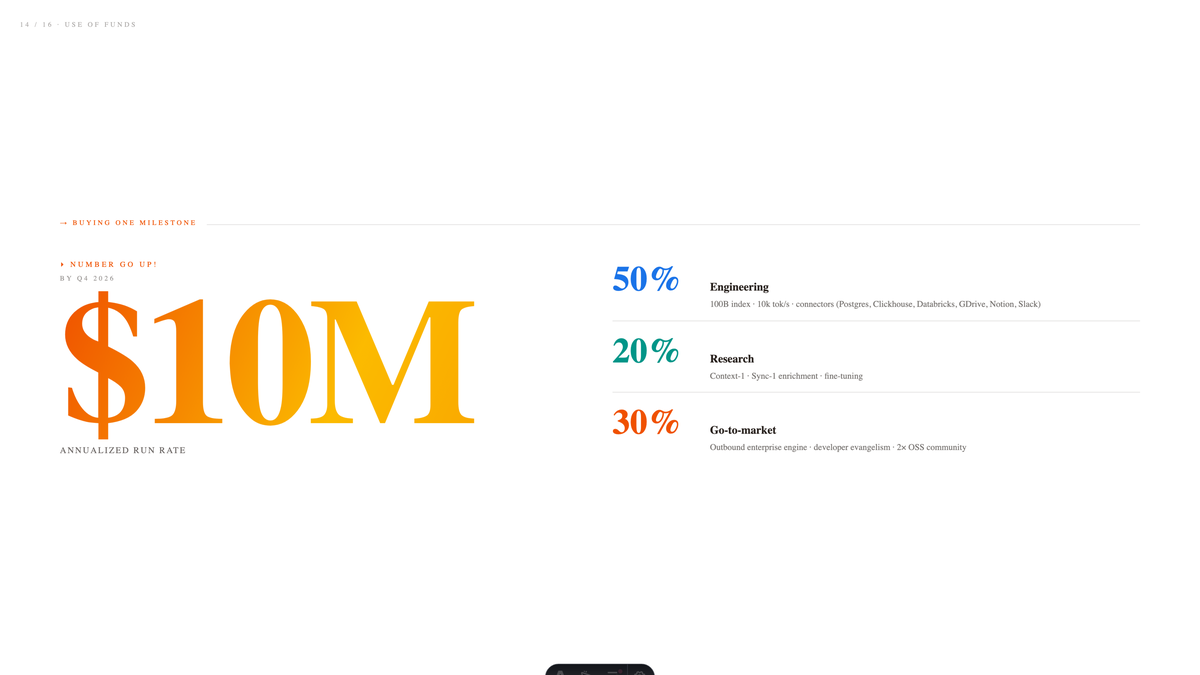
Series A capital allocated across three priorities:
Engineering (50% / $17.5M): Build 100B index capability, develop 10k tok/s connectors for Postgres, Clickhouse, Databricks, GDrive, Notion, and Slack. Expand core infrastructure team.
Research (20% / $7M): Advance Context-1 model performance, develop Sync-1 enrichment capabilities, build fine-tuning infrastructure for enterprise customization.
Go-to-Market & Operations (30% / $10.5M): Scale enterprise sales to reach $10M run rate by Q4 2026, expand customer success for design partners (Anthropic, Cursor, Replit, Runway, Zapier), achieve 2x OSS community growth.
Runway & Milestones
Current burn rate not disclosed. Series A targets 18-24 month runway to Series B milestones: 3,000 tok/s throughput, 100B+ dataset support, and $10M ARR. Revenue metrics and current ARR not disclosed, though design partner roster and XAI production deployment suggest meaningful commercial validation underway.
Closing Assessment
Chroma presents a compelling infrastructure play at the intersection of three converging forces: the maturation of vector search from experimental to production-critical, the emergence of persistent agent systems requiring memory layers, and the architectural shift from monolithic LLMs to retrieval-augmented systems. The company has executed a textbook developer-led GTM strategy, converting 15 million monthly downloads and 90,000+ dependent codebases into genuine mindshare during the AI infrastructure land grab. The technical fundamentals are increasingly robust—4x performance improvements in v1.0, p50 query latency of 20ms, and a cost structure "up to 10x cheaper" than legacy systems through object storage architecture. The $2.4M cloud run rate from 50K teams, achieved with ~$30M in capital versus Pinecone's $138M, demonstrates capital efficiency and validates commercial traction beyond open-source adoption. The August 2026 Foundation launch represents strategic foresight, moving upmarket from ephemeral search to persistent memory infrastructure before competitors recognize the category shift. The cap table—Naval Ravikant, Altman brothers, and founders from CockroachDB, Replit, Vercel, and Notion—provides both capital and distribution leverage within the developer ecosystem.
However, three structural risks temper enthusiasm and warrant deeper investigation. First, the open-source moat is inherently fragile under Apache 2.0 licensing—Oracle's positioning of its AI Vector Search as superior to "Chroma and other standalone vector databases" demonstrates how database incumbents can absorb vector capabilities and bundle them with enterprise features (high availability, security, query optimization) that standalone vendors must build from scratch. The performance moat is temporary; competitors like Pinecone emphasize "consistent performance at any scale" with p99 latency "improving with scale," and algorithmic advantages commoditize quickly in infrastructure categories. Second, the gap between open-source adoption and cloud monetization remains unproven at scale—while 15M monthly downloads signal developer preference, the conversion mechanics from free local prototyping to paid cloud deployment face headwinds from (a) Pinecone's $50-500/month pricing establishing willingness-to-pay benchmarks Chroma must match or undercut, (b) the operational complexity of migrating from SQLite-backed local instances to distributed cloud infrastructure, and (c) competitive pressure from Weaviate's "billion-scale architecture" and Elasticsearch's existing enterprise relationships. The waitlist-mode Cloud access suggests supply constraints rather than demand validation. Third, Foundation's memory infrastructure thesis, while strategically sound, introduces execution risk across auth, provenance, ACLs, and knowledge graph management—capabilities orthogonal to Chroma's core vector search competency and requiring different technical talent, sales motion, and customer success infrastructure than database offerings.
Recommendation: CONSIDER with conditional advancement. Chroma merits serious consideration contingent on satisfactory resolution of three critical due diligence workstreams. First, validate cloud unit economics and conversion funnels: obtain cohort data showing progression from open-source download → cloud trial → paid tier → enterprise BYOC, with specific focus on (a) time-to-conversion metrics, (b) average contract values by customer segment, (c) gross retention and net dollar retention for cloud customers past 12 months, and (d) customer acquisition cost breakdown between developer-led inbound versus outbound enterprise sales. The $2.4M run rate from 50K teams implies ~$48 average annual revenue per team—clarify whether this reflects early-stage land motion or sustainable monetization. Second, assess Foundation product-market fit independently from core database traction: conduct reference calls with design partners using Foundation in production to validate whether the memory infrastructure thesis resonates beyond the CEO's vision, understand integration complexity with existing agent frameworks, and pressure-test whether customers view this as core Chroma infrastructure or experimental side project. The "100% human readable wikis" positioning suggests product definition is still evolving. Third, stress-test competitive positioning against database incumbents: model scenarios where Oracle, Elasticsearch, and cloud hyperscalers (AWS, GCP, Azure) bundle vector search into existing database offerings at marginal cost, and evaluate whether Chroma's developer experience advantages and cost structure create sufficient switching costs to defend against zero-marginal-cost bundling. If these workstreams validate (1) a clear path from 15M downloads to $50M+ ARR with healthy unit economics, (2) genuine customer pull for Foundation beyond search infrastructure, and (3) defensible moats beyond temporary performance leads, Chroma represents a high-conviction Series A opportunity in a category with secular tailwinds and a team demonstrating both technical depth and commercial discipline.